Advertisements
Advertisements
प्रश्न
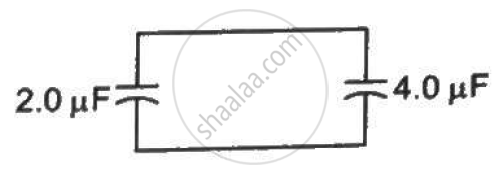
A capacitor of capacitance 2⋅0 µF is charged to a potential difference of 12 V. It is then connected to an uncharged capacitor of capacitance 4⋅0 µF as shown in figure . Find (a) the charge on each of the two capacitors after the connection, (b) the electrostatic energy stored in each of the two capacitors and (c) the heat produced during the charge transfer from one capacitor to the other.
Advertisements
उत्तर
Charge on the 2 µF capacitor when it is not connected to the 4 µF capacitor is given by
`q = C xx V = 12 xx 2 xx 10^-6`
`⇒ q = 24 xx 10^-6 "C"`
(a) On connecting the capacitors, the charge flows from the 2 µF capacitor to the 4 µF capacitor.
Now, let the charges on the 2 µF and 4 µF capacitors be q1 and q2, respectively.
As they are connected in parallel, the potential difference across them is the same.
`therefore V = q_1/C_1 = q_2/C_2`
`⇒ V = q_1/2 = q_2/4`
`⇒ q_2 = 2 q_1`
The total charge on the capacitors will be the same as the initial charge stored on the 2 µF capacitor.
`therefore q_1 + q_2 = 24 xx 10^-6`
`⇒ 3 q_1 = 24 xx 10^-6 C`
`⇒ q_1 = 8 xx 10^-6 C = 8 muC`
`⇒ q_1 = 2 q_1 = 16 muC`
(b) Energies stored in the capacitors are given by
`E_1 = 1/2 xx q_1^2/C_1 = 16 muJ`
and
`E_2 = 1/2 xx q_2^2/C_2 = 32 muJ`
(c) Initial energy stored in the 2 µF capacitor is given by
`E_i = 1/2 CV^2 = 1/2 xx (2 xx 10^-6) (12)^2`
`⇒ E_i = 144 muJ`
Total energy of the capacitors after they are connected in parallel is given by
Ef = E1 + E2
⇒ Ef = 16 + 32 = 48 μJ
Heat produced during the charge transfer is given by
`E = E_f - E_i`
`⇒ E = 144 - 48 = 96 muJ`
APPEARS IN
संबंधित प्रश्न
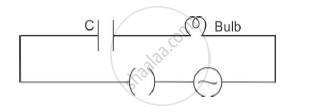
A bulb is connected in series with a variable capacitor and an AC source as shown. What happens to the brightness of the bulb when the key is plugged in and capacitance of the capacitor is gradually reduced?
A capacitor of capacitance ‘C’ is charged to ‘V’ volts by a battery. After some time the battery is disconnected and the distance between the plates is doubled. Now a slab of dielectric constant, 1 < k < 2, is introduced to fill the space between the plates. How will the following be affected? (b) The energy stored in the capacitor Justify your answer by writing the necessary expressions
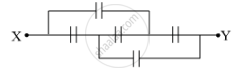
Find the equivalent capacitance of the network shown in the figure, when each capacitor is of 1 μF. When the ends X and Y are connected to a 6 V battery, find out (i) the charge and (ii) the energy stored in the network.
As `C = (1/V) Q` , can you say that the capacitance C is proportional to the charge Q?
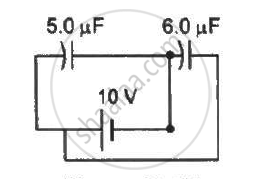
Find the charge supplied by the battery in the arrangement shown in figure.
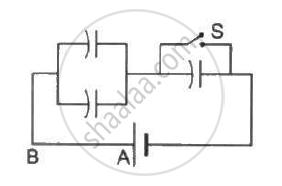
Each capacitor shown in figure has a capacitance of 5⋅0 µF. The emf of the battery is 50 V. How much charge will flow through AB if the switch S is closed?
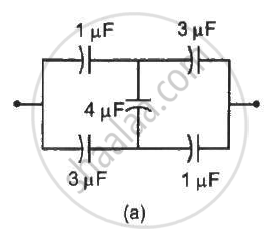
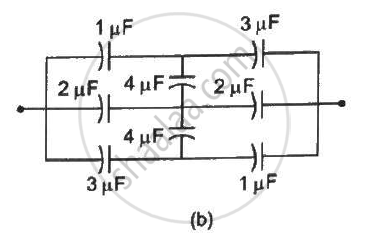
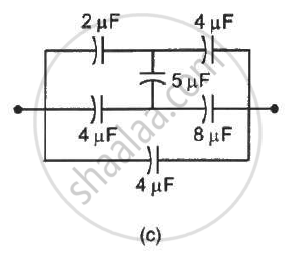
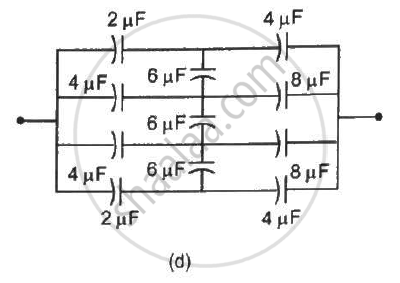
Find the equivalent capacitances of the combinations shown in figure between the indicated points.
A parallel-plate capacitor of capacitance 5 µF is connected to a battery of emf 6 V. The separation between the plates is 2 mm. (a) Find the charge on the positive plate. (b) Find the electric field between the plates. (c) A dielectric slab of thickness 1 mm and dielectric constant 5 is inserted into the gap to occupy the lower half of it. Find the capacitance of the new combination. (d) How much charge has flown through the battery after the slab is inserted?
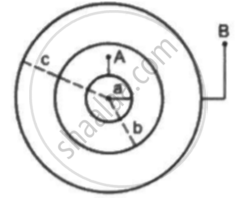
Consider an assembly of three conducting concentric spherical shell of radii a, b and c as shown in figure Find the capacitance of the assembly between the points Aand B.
Obtain the expression for energy stored in the parallel plate capacitor.
Can the potential function have a maximum or minimum in free space?
The material filled between the plates of a parallel plate capacitor has a resistivity of 200Ωm. The value of the capacitance of the capacitor is 2 pF. If a potential difference of 40V is applied across the plates of the capacitor, then the value of leakage current flowing out of the capacitor is ______.
(given the value of relative permittivity of a material is 50.)
A 5µF capacitor is charged fully by a 220 V supply. It is then disconnected from the supply and is connected in series to another uncharged 2.5 µF capacitor If the energy change during the charge redistribution is `"X"/100`J then value of X to the 100 nearest integer is ______.
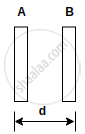
Two plates A and B of a parallel plate capacitor are arranged in such a way, that the area of each plate is S = 5 × 10⁻³ m 2 and distance between them is d = 8.85 mm. Plate A has a positive charge q1 = 10-10 C and Plate B has charge q2 = + 2 × 10⁻¹⁰ C. Then the charge induced on the plate B due to the plate A be - (....... × 10-11 )C
Which units are capacitors commonly measured in practice?
Which statement lists the factors on which capacitance depends?
For a given capacitor, what fixes its capacitance?
What is the practical purpose of a parallel combination of capacitors?
Which statement describes the voltage and use of a parallel combination?
