Advertisements
Advertisements
प्रश्न
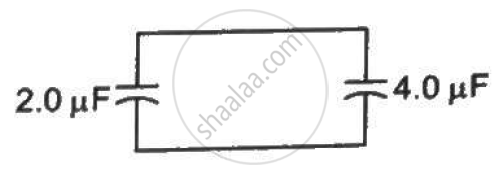
A capacitor of capacitance 2⋅0 µF is charged to a potential difference of 12 V. It is then connected to an uncharged capacitor of capacitance 4⋅0 µF as shown in figure . Find (a) the charge on each of the two capacitors after the connection, (b) the electrostatic energy stored in each of the two capacitors and (c) the heat produced during the charge transfer from one capacitor to the other.
Advertisements
उत्तर
Charge on the 2 µF capacitor when it is not connected to the 4 µF capacitor is given by
`q = C xx V = 12 xx 2 xx 10^-6`
`⇒ q = 24 xx 10^-6 "C"`
(a) On connecting the capacitors, the charge flows from the 2 µF capacitor to the 4 µF capacitor.
Now, let the charges on the 2 µF and 4 µF capacitors be q1 and q2, respectively.
As they are connected in parallel, the potential difference across them is the same.
`therefore V = q_1/C_1 = q_2/C_2`
`⇒ V = q_1/2 = q_2/4`
`⇒ q_2 = 2 q_1`
The total charge on the capacitors will be the same as the initial charge stored on the 2 µF capacitor.
`therefore q_1 + q_2 = 24 xx 10^-6`
`⇒ 3 q_1 = 24 xx 10^-6 C`
`⇒ q_1 = 8 xx 10^-6 C = 8 muC`
`⇒ q_1 = 2 q_1 = 16 muC`
(b) Energies stored in the capacitors are given by
`E_1 = 1/2 xx q_1^2/C_1 = 16 muJ`
and
`E_2 = 1/2 xx q_2^2/C_2 = 32 muJ`
(c) Initial energy stored in the 2 µF capacitor is given by
`E_i = 1/2 CV^2 = 1/2 xx (2 xx 10^-6) (12)^2`
`⇒ E_i = 144 muJ`
Total energy of the capacitors after they are connected in parallel is given by
Ef = E1 + E2
⇒ Ef = 16 + 32 = 48 μJ
Heat produced during the charge transfer is given by
`E = E_f - E_i`
`⇒ E = 144 - 48 = 96 muJ`
APPEARS IN
संबंधित प्रश्न
Define capacitor reactance. Write its S.I units.
A spherical capacitor consists of two concentric spherical conductors, held in position by suitable insulating supports. Show that the capacitance of a spherical capacitor is given by
C = `(4piin_0"r"_1"r"_2)/("r"_1 - "r"_2)`
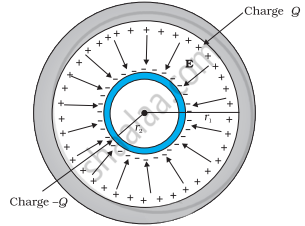
where r1 and r2 are the radii of outer and inner spheres, respectively.
A spherical capacitor has an inner sphere of radius 12 cm and an outer sphere of radius 13 cm. The outer sphere is earthed and the inner sphere is given a charge of 2.5 µC. The space between the concentric spheres is filled with a liquid of dielectric constant 32.
(a) Determine the capacitance of the capacitor.
(b) What is the potential of the inner sphere?
(c) Compare the capacitance of this capacitor with that of an isolated sphere of radius 12 cm. Explain why the latter is much smaller.
Two identical capacitors of 12 pF each are connected in series across a battery of 50 V. How much electrostatic energy is stored in the combination? If these were connected in parallel across the same battery, how much energy will be stored in the combination now?
Also find the charge drawn from the battery in each case.
A capacitor of unknown capacitance is connected across a battery of V volts. The charge stored in it is 300 μC. When potential across the capacitor is reduced by 100 V, the charge stored in it becomes 100 μC. Calculate The potential V and the unknown capacitance. What will be the charge stored in the capacitor if the voltage applied had increased by 100 V?
A capacitor of capacitance C is charged to a potential V. The flux of the electric field through a closed surface enclosing the capacitor is
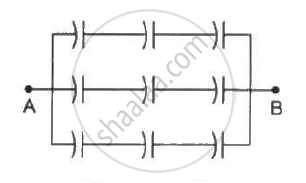
Each of the capacitors shown in figure has a capacitance of 2 µF. find the equivalent capacitance of the assembly between the points A and B. Suppose, a battery of emf 60 volts is connected between A and B. Find the potential difference appearing on the individual capacitors.
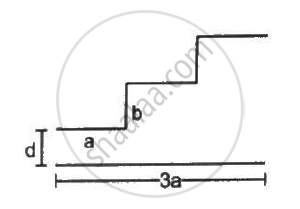
A capacitor is made of a flat plate of area A and a second plate having a stair-like structure as shown in figure . The width of each stair is a and the height is b. Find the capacitance of the assembly.
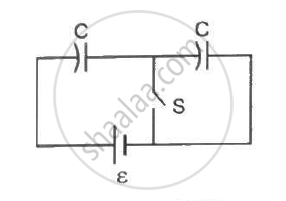
Consider the situation shown in the figure. The switch S is open for a long time and then closed. (a) Find the charge flown through the battery when the switch S is closed. (b) Find the work done by the battery.(c) Find the change in energy stored in the capacitors.(d) Find the heat developed in the system.
A parallel-plate capacitor of plate area A and plate separation d is charged to a potential difference V and then the battery is disconnected. A slab of dielectric constant K is then inserted between the plates of the capacitor so as to fill the space between the plates. Find the work done on the system in the process of inserting the slab.
Suppose the space between the two inner shells is filled with a dielectric of dielectric constant K. Find the capacitance of the system between A and B.
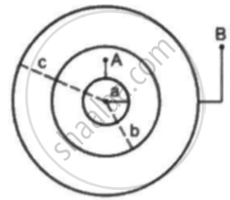
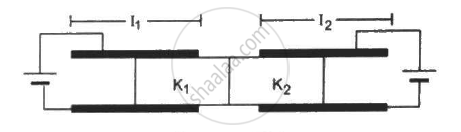
Figure shows two parallel plate capacitors with fixed plates and connected to two batteries. The separation between the plates is the same for the two capacitors. The plates are rectangular in shape with width b and lengths l1 and l2. The left half of the dielectric slab has a dielectric constant K1 and the right half K2. Neglecting any friction, find the ration of the emf of the left battery to that of the right battery for which the dielectric slab may remain in equilibrium.
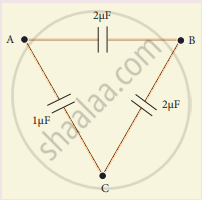
Three capacitors are connected in a triangle as shown in the figure. The equivalent capacitance between points A and C is ______.
Obtain the expression for capacitance for a parallel plate capacitor.
The radius of a sphere of capacity 1 microfarad in the air is ______
Between the plates of parallel plate condenser there is 1 mm thick medium shoot of dielectric constant 4. It is charged at 100 volt. The electric field in volt/meter between the plates of capacitor is ______.
The displacement current of 4.425 µA is developed in the space between the plates of the parallel plate capacitor when voltage is changing at a rate of 106 Vs-1. The area of each plate of the capacitor is 40 cm2. The distance between each plate of the capacitor is x × 10-3 m. The value of x is ______.
(Permittivity of free space, ε0 = 8.85 × 10⁻¹²C2N-1m-2).
Which expression gives the capacitance of a capacitor?
Which combination has charge as its constant quantity and potential difference as its variable quantity?
In a parallel combination, which quantity is the same across each capacitor?
