Advertisements
Advertisements
Question
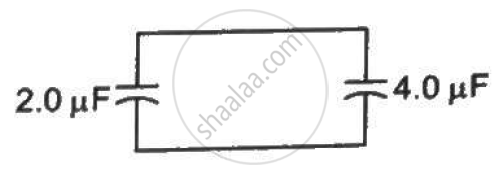
A capacitor of capacitance 2⋅0 µF is charged to a potential difference of 12 V. It is then connected to an uncharged capacitor of capacitance 4⋅0 µF as shown in figure . Find (a) the charge on each of the two capacitors after the connection, (b) the electrostatic energy stored in each of the two capacitors and (c) the heat produced during the charge transfer from one capacitor to the other.
Advertisements
Solution
Charge on the 2 µF capacitor when it is not connected to the 4 µF capacitor is given by
`q = C xx V = 12 xx 2 xx 10^-6`
`⇒ q = 24 xx 10^-6 "C"`
(a) On connecting the capacitors, the charge flows from the 2 µF capacitor to the 4 µF capacitor.
Now, let the charges on the 2 µF and 4 µF capacitors be q1 and q2, respectively.
As they are connected in parallel, the potential difference across them is the same.
`therefore V = q_1/C_1 = q_2/C_2`
`⇒ V = q_1/2 = q_2/4`
`⇒ q_2 = 2 q_1`
The total charge on the capacitors will be the same as the initial charge stored on the 2 µF capacitor.
`therefore q_1 + q_2 = 24 xx 10^-6`
`⇒ 3 q_1 = 24 xx 10^-6 C`
`⇒ q_1 = 8 xx 10^-6 C = 8 muC`
`⇒ q_1 = 2 q_1 = 16 muC`
(b) Energies stored in the capacitors are given by
`E_1 = 1/2 xx q_1^2/C_1 = 16 muJ`
and
`E_2 = 1/2 xx q_2^2/C_2 = 32 muJ`
(c) Initial energy stored in the 2 µF capacitor is given by
`E_i = 1/2 CV^2 = 1/2 xx (2 xx 10^-6) (12)^2`
`⇒ E_i = 144 muJ`
Total energy of the capacitors after they are connected in parallel is given by
Ef = E1 + E2
⇒ Ef = 16 + 32 = 48 μJ
Heat produced during the charge transfer is given by
`E = E_f - E_i`
`⇒ E = 144 - 48 = 96 muJ`
APPEARS IN
RELATED QUESTIONS
When an AC source is connected to an ideal capacitor, show that the average power supplied by the source over a complete cycle is zero
A spherical capacitor has an inner sphere of radius 12 cm and an outer sphere of radius 13 cm. The outer sphere is earthed and the inner sphere is given a charge of 2.5 µC. The space between the concentric spheres is filled with a liquid of dielectric constant 32.
(a) Determine the capacitance of the capacitor.
(b) What is the potential of the inner sphere?
(c) Compare the capacitance of this capacitor with that of an isolated sphere of radius 12 cm. Explain why the latter is much smaller.
(i) Find equivalent capacitance between A and B in the combination given below. Each capacitor is of 2 µF capacitance.
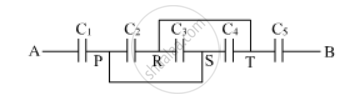
(ii) If a dc source of 7 V is connected across AB, how much charge is drawn from the source and what is the energy stored in the network?
Two metal spheres of capacitance C1 and C2 carry some charges. They are put in contact and then separated. The final charges Q1 and Q2 on them will satisfy
A parallel-plate capacitor has plate area 25⋅0 cm2 and a separation of 2⋅00 mm between the plates. The capacitor is connected to a battery of 12⋅0 V. (a) Find the charge on the capacitor. (b) The plate separation is decreased to 1⋅00 mm. Find the extra charge given by the battery to the positive plate.
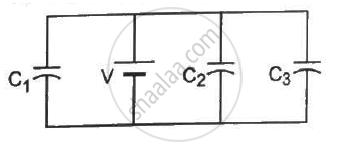
Find the charges on the three capacitors connected to a battery as shown in figure.
Take `C_1 = 2.0 uF , C_2 = 4.0 uF , C_3 = 6.0 uF and V` = 12 volts.
Two conducting spheres of radii R1 and R2 are kept widely separated from each other. What are their individual capacitances? If the spheres are connected by a metal wire, what will be the capacitance of the combination? Think in terms of series−parallel connections.
It is required to construct a 10 µF capacitor which can be connected across a 200 V battery. Capacitors of capacitance 10 µF are available but they can withstand only 50 V. Design a combination which can yield the desired result.
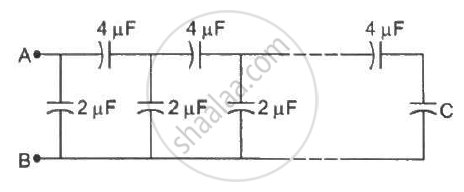
A finite ladder is constructed by connecting several sections of 2 µF, 4 µF capacitor combinations as shown in the figure. It is terminated by a capacitor of capacitance C. What value should be chosen for C, such that the equivalent capacitance of the ladder between the points A and B becomes independent of the number of sections in between?
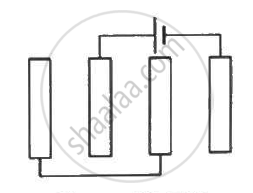
Each of the plates shown in figure has surface area `(96/∈_0) xx 10^-12` Fm on one side and the separation between the consecutive plates is 4⋅0 mm. The emf of the battery connected is 10 volts. Find the magnitude of the charge supplied by the battery to each of the plates connected to it.
A 5⋅0 µF capacitor is charged to 12 V. The positive plate of this capacitor is now connected to the negative terminal of a 12 V battery and vice versa. Calculate the heat developed in the connecting wires.
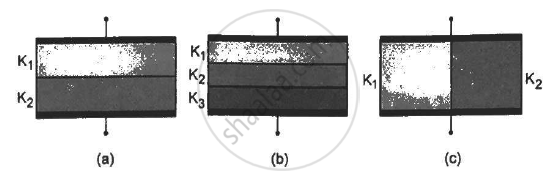
Find the capacitances of the capacitors shown in figure . The plate area is Aand the separation between the plates is d. Different dielectric slabs in a particular part of the figure are of the same thickness and the entire gap between the plates is filled with the dielectric slabs.
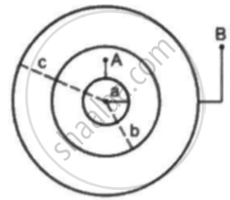
Suppose the space between the two inner shells is filled with a dielectric of dielectric constant K. Find the capacitance of the system between A and B.
Obtain the expression for energy stored in the parallel plate capacitor.
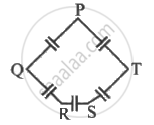
Five capacitor each of capacitance value C are connected as shown in the figure. The ratio of capacitance between P to R, and the capacitance between P and Q is ______.
The displacement current of 4.425 µA is developed in the space between the plates of the parallel plate capacitor when voltage is changing at a rate of 106 Vs-1. The area of each plate of the capacitor is 40 cm2. The distance between each plate of the capacitor is x × 10-3 m. The value of x is ______.
(Permittivity of free space, ε0 = 8.85 × 10⁻¹²C2N-1m-2).
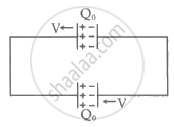
Two identical capacitors are connected as shown and have an initial charge of Q0. The separation between the plates of each capacitor is d0. Suddenly the left plate of the upper capacitor and right plate of the lower capacitor start moving with speed v towards the left while the other plate of each capacitor remains fixed. `("given" (Q_0V)/(2d_0) = 10 A)`. The value of current in the circuit is ______ A.
For the same potential difference, what does a larger capacitance mean?
What does a large capacitance mean in terms of charge storage and potential difference?
