Advertisements
Advertisements
Question
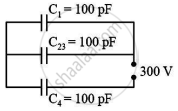
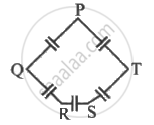
Obtain the equivalent capacitance of the network shown in the figure. For a 300 V supply, determine the charge on each capacitor.

Advertisements
Solution
 |
 |
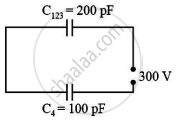 |
The equivalent capacitance = `200/3` pF
charge on C4 = `200/3 xx 10^-12 xx 300 = 2 xx 10^-8` C,
the potential difference across C4 = `(200 xx 10^-12 xx 300)/(3 xx 100 xx 10^-12)` = 200 V
potential difference across C1 = 300 - 200 = 100 V
charge on C1 = 100 × 10-12 × 100 = 1 × 10⁻⁸ C
potential difference across C2 and C3 series combination = 100 V
potential difference across C2 and C3 each = 50 V
charge on C2 and C3 each = 200 × 10-12 × 50 = 1 × 10⁻⁸ C
APPEARS IN
RELATED QUESTIONS
Define capacitor reactance. Write its S.I units.
As `C = (1/V) Q` , can you say that the capacitance C is proportional to the charge Q?
The equivalent capacitance of the combination shown in the figure is _________ .
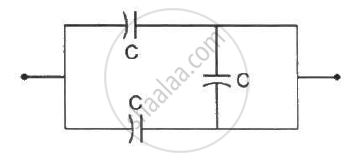
Find the equivalent capacitance of the system shown in figure between the points a and b.
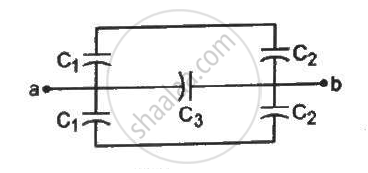
A capacitor of capacitance 10 μF is connected to a battery of emf 2 V. It is found that it takes 50 ms for the charge of the capacitor to become 12.6 μC. Find the resistance of the circuit.
The separation between the plates of a parallel-plate capacitor is 0⋅500 cm and its plate area is 100 cm2. A 0⋅400 cm thick metal plate is inserted into the gap with its faces parallel to the plates. Show that the capacitance of the assembly is independent of the position of the metal plate within the gap and find its value.
Derive the expression for resultant capacitance, when the capacitor is connected in series.
Five capacitor each of capacitance value C are connected as shown in the figure. The ratio of capacitance between P to R, and the capacitance between P and Q is ______.
A capacitor with capacitance 5µF is charged to 5 µC. If the plates are pulled apart to reduce the capacitance to 2 µF, how much work is done?
Eight drops of mercury of equal radius and possessing equal charge combine to form a big drop. The capacitance of bigger drop as compared to each small drop is ______.
