Advertisements
Advertisements
Question
Following operations can be performed on a capacitor:
X − connect the capacitor to a battery of emf ε.
Y − disconnect the battery.
Z − reconnect the battery with polarity reversed.
W − insert a dielectric slab in the capacitor.
(a) In XYZ (perform X, then Y, then Z) the stored electric energy remains unchanged and no thermal energy is developed.
(b) The charge appearing on the capacitor is greater after the action XWY than after the action XYZ.
(c) The electric energy stored in the capacitor is greater after the action WXY than after the action XYW.
(d) The electric field in the capacitor after the action XW is the same as that after WX.
Advertisements
Solution
(b) The charge appearing on the capacitor is greater after the action XWY than after the action XYZ.
(c) The electric energy stored in the capacitor is greater after the action WXY than after the action XYW.
(d) The electric field in the capacitor after the action XW is the same as that after WX.
Justification of option (b)
If the potential is held constant, that is, the battery remains attached to the circuit, then the charge on the capacitor increases by a factor of K on inserting a dielectric of a dielectric constant K between the plates of the capacitor.
Mathematically,
q = Kq0
Here, q0 and q are the charges without dielectric and with dielectric, respectively.
The amount of charge stored does not depend upon the polarity of the plates.
Thus, the charge appearing on the capacitor is greater after the action XWY than after the action XYZ.
Justification of option (c)
Since the battery is disconnected before inserting a dielectric, the amount of charge remains constant, that is,q = q0, because after the battery is disconnected, the capacitor gets no source to store charge from. In other words, the capacitor is now an isolated system where the amount of charge is conserved and so is the energy U as `1/2q∈` . Hence, inserting a dielectric after disconnecting the battery will not bring any change in the amount of charge stored in the capacitor. So, the energy stored in the capacitor will also not change after the action XYW.
However, during the action WXY, the amount of charge that will get stored in the capacitor will get increased by a factor of K, as the battery is disconnected after inserting a dielectric between the plates of the capacitor and the energy stored will also get multiplied by a factor of K.
Thus, the electric energy stored in the capacitor is greater after the action WXY than after the action XYW.
Justification of option (d)
The electric field between the plates E depends on the potential across the capacitor and the distanced between the plates of the capacitor.
Mathematically,
`E = ∈/d`
In either case, that is, during actions XW and WX, the potential remains the same, that is, ∈. Thus, the electric field E remains the same.
Denial of option (a)
During the action XYZ, the battery has to do extra work equivalent to `1/2CV^2` to change the polarity of the plates of the capacitor. In other words, the total work to be done by the battery will be `1/2CV^2+1/2CV^2` . This extra work done will be dissipated as heat energy. Thus, thermal energy is developed. However, the stored electric energy remains unchanged, that is `1/2CV^2` .
APPEARS IN
RELATED QUESTIONS
(i) Find equivalent capacitance between A and B in the combination given below. Each capacitor is of 2 µF capacitance.
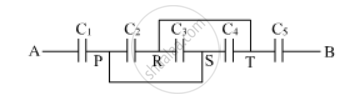
(ii) If a dc source of 7 V is connected across AB, how much charge is drawn from the source and what is the energy stored in the network?
Two capacitors each having capacitance C and breakdown voltage V are joined in series. The capacitance and the breakdown voltage of the combination will be
When 1⋅0 × 1012 electrons are transferred from one conductor to another, a potential difference of 10 V appears between the conductors. Calculate the capacitance of the two-conductor system.
It is required to construct a 10 µF capacitor which can be connected across a 200 V battery. Capacitors of capacitance 10 µF are available but they can withstand only 50 V. Design a combination which can yield the desired result.
Find the equivalent capacitance of the infinite ladder shown in figure between the points A and B.
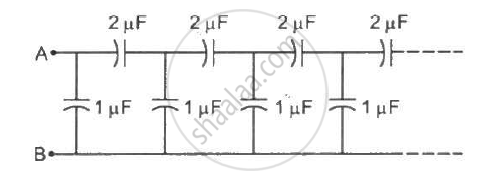
Obtain an expression for equivalent capacitance when three capacitors C1, C2 and C3 are connected in series.
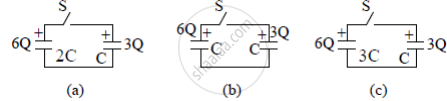
Three circuits, each consisting of a switch 'S' and two capacitors, are initially charged, as shown in the figure. After the switch has been closed, in which circuit will the charge on the left-hand capacitor
(i) increase,
(ii) decrease, and
(iii) remains the same? Give reasons.
If the voltage applied on a capacitor is increased from V to 2V, choose the correct conclusion.
A parallel plate capacitor stores a charge Q at a voltage V. Suppose the area of the parallel plate capacitor and the distance between the plates are each doubled then which is the quantity that will change?
The work done in placing a charge of 8 × 10–18 coulomb on a condenser of capacity 100 micro-farad is ______.
When air is replaced by a dielectric medium of constant K, the maximum force of attraction between two charges separated by a distance ______.
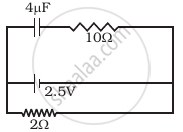
A capacitor of 4 µ F is connected as shown in the circuit (Figure). The internal resistance of the battery is 0.5 Ω. The amount of charge on the capacitor plates will be ______.
A 5µF capacitor is charged fully by a 220 V supply. It is then disconnected from the supply and is connected in series to another uncharged 2.5 µF capacitor If the energy change during the charge redistribution is `"X"/100`J then value of X to the 100 nearest integer is ______.
A leaky parallel plate capacitor is filled completely with a material having dielectric constant K = 5 and electric conductivity σ = 7.4 × 10⁻¹² Ω-1 m-1. If the charge on the plate at the instant t = 0 is q = 8.85 µC, then the leakage current at the instant t = 12 s is ______ × 10-1 µA.
A capacitor has charge 50 µC. When the gap between the plate is filled with glass wool, then 120 µC charge flows through the battery to capacitor. The dielectric constant of glass wool is ______.
The plates of a parallel plate capacitor are separated by d. Two slabs of different dielectric constant K1 and K2 with thickness `3/8 d and d/2`, respectively, are inserted in the capacitor. Due to this, the capacitance becomes two times larger than when there is nothing between the plates. If K1 = 1.25 K, the value of K1 is:
Which system is called a capacitor?
Which set lists the factors on which capacitance depends?
In a series combination, which quantity is the same on each capacitor?
