Advertisements
Advertisements
Question
A parallel-plate capacitor of capacitance 5 µF is connected to a battery of emf 6 V. The separation between the plates is 2 mm. (a) Find the charge on the positive plate. (b) Find the electric field between the plates. (c) A dielectric slab of thickness 1 mm and dielectric constant 5 is inserted into the gap to occupy the lower half of it. Find the capacitance of the new combination. (d) How much charge has flown through the battery after the slab is inserted?
Advertisements
Solution
For the given capacitor,
`C = 5 "uF"`
V = 6 V
`d = 2 "mm" = 2 xx 10^-3 "m"`
(a) The charge on the positive plate is calculated using q = CV.
Thus,
`q = 5 "uF" xx 6 V = 30 "uC"`
(b) The electric field between the plates of the capacitor is given by
`E = V/d = 3 xx 10^3 "V/m"`
(c) Separation between the plates of the capacitor, d = `2 xx 10^-3 "m"`
Dielectric constant of the dielectric inserted, k = 5
Thickness of the dielectric inserted, t = `1 xx 10^-3 "m"`
Now ,
Area of the plates of the capacitor `C = (∈_0A)/d`
⇒ `5 xx 10^-6 = (8.85 xx 10^-12 xx A)/(2 xx 10^-3)`
⇒ `10^4 = 8.85 xx A`
⇒ `A = 10^4 xx 1/8.85`
When the dielectric placed in it, the capacitance becomes
⇒ `C_1 = (∈_0A)/(d-t+t/k)`
⇒ `C_1 = (8.85 xx 10^-12 xx 10^4/8.85)/(2 xx 10^-3-10^-3+(10-3)/5)`
⇒ `C_1 = (8.85 xx 10^-12 xx 10^4/8.85)/(10^-3+(10-3)/5)`
⇒ `C_1 = (10^-12 xx 10^4 xx 5)/(6 xx 10^-3) = 8.33 "uF"`
(d)
The charge stored in the capacitor initially is given by
`C = 5 xx 10^-6 "F"`
Also ,
V = 6 V
Now ,
`Q = CV = 3 xx 10^-5 "F"`
⇒`Q = 30 "uC"`
The charge on the capacitor after inserting the dielectric slab is given by
`C_1 = 8.3 xx 10^-6 "F"`
`therefore Q^' = C_1V = 8.3 xx 6 xx 10^-6`
⇒ `Q^' = 50 "uC"`
Now ,
Charge flown , `Q^' - Q = 20 "uC"`
APPEARS IN
RELATED QUESTIONS
As `C = (1/V) Q` , can you say that the capacitance C is proportional to the charge Q?
Following operations can be performed on a capacitor:
X − connect the capacitor to a battery of emf ε.
Y − disconnect the battery.
Z − reconnect the battery with polarity reversed.
W − insert a dielectric slab in the capacitor.
(a) In XYZ (perform X, then Y, then Z) the stored electric energy remains unchanged and no thermal energy is developed.
(b) The charge appearing on the capacitor is greater after the action XWY than after the action XYZ.
(c) The electric energy stored in the capacitor is greater after the action WXY than after the action XYW.
(d) The electric field in the capacitor after the action XW is the same as that after WX.
Three capacitors having capacitances 20 µF, 30 µF and 40 µF are connected in series with a 12 V battery. Find the charge on each of the capacitors. How much work has been done by the battery in charging the capacitors?
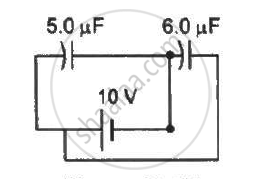
Find the charge supplied by the battery in the arrangement shown in figure.
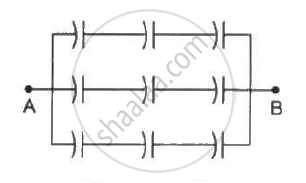
Each of the capacitors shown in figure has a capacitance of 2 µF. find the equivalent capacitance of the assembly between the points A and B. Suppose, a battery of emf 60 volts is connected between A and B. Find the potential difference appearing on the individual capacitors.
A cylindrical capacitor is constructed using two coaxial cylinders of the same length 10 cm and of radii 2 mm and 4 mm. (a) Calculate the capacitance. (b) Another capacitor of the same length is constructed with cylinders of radii 4 mm and 8 mm. Calculate the capacitance.
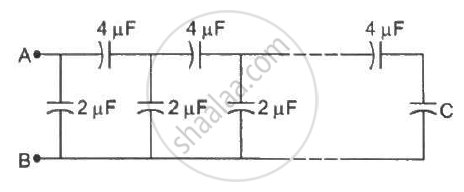
A finite ladder is constructed by connecting several sections of 2 µF, 4 µF capacitor combinations as shown in the figure. It is terminated by a capacitor of capacitance C. What value should be chosen for C, such that the equivalent capacitance of the ladder between the points A and B becomes independent of the number of sections in between?
A 5⋅0 µF capacitor is charged to 12 V. The positive plate of this capacitor is now connected to the negative terminal of a 12 V battery and vice versa. Calculate the heat developed in the connecting wires.
The two square faces of a rectangular dielectric slab (dielectric constant 4⋅0) of dimensions 20 cm × 20 cm × 1⋅0 mm are metal-coated. Find the capacitance between the coated surfaces.
The separation between the plates of a parallel-plate capacitor is 0⋅500 cm and its plate area is 100 cm2. A 0⋅400 cm thick metal plate is inserted into the gap with its faces parallel to the plates. Show that the capacitance of the assembly is independent of the position of the metal plate within the gap and find its value.
A parallel-plate capacitor has plate area 100 cm2 and plate separation 1⋅0 cm. A glass plate (dielectric constant 6⋅0) of thickness 6⋅0 mm and an ebonite plate (dielectric constant 4⋅0) are inserted one over the other to fill the space between the plates of the capacitor. Find the new capacitance.
Derive the expression for resultant capacitance, when the capacitor is connected in parallel.
The work done in placing a charge of 8 × 10–18 coulomb on a condenser of capacity 100 micro-farad is ______.
A parallel plate capacitor is filled by a dielectric whose relative permittivity varies with the applied voltage (U) as ε = αU where α = 2V–1. A similar capacitor with no dielectric is charged to U0 = 78V. It is then connected to the uncharged capacitor with the dielectric. Find the final voltage on the capacitors.
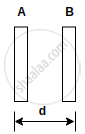
Two plates A and B of a parallel plate capacitor are arranged in such a way, that the area of each plate is S = 5 × 10⁻³ m 2 and distance between them is d = 8.85 mm. Plate A has a positive charge q1 = 10-10 C and Plate B has charge q2 = + 2 × 10⁻¹⁰ C. Then the charge induced on the plate B due to the plate A be - (....... × 10-11 )C
Calculate equivalent capacitance of the circuit shown in the Figure given below:

The plates of a parallel plate capacitor are separated by d. Two slabs of different dielectric constant K1 and K2 with thickness `3/8 d and d/2`, respectively, are inserted in the capacitor. Due to this, the capacitance becomes two times larger than when there is nothing between the plates. If K1 = 1.25 K, the value of K1 is:
Which units are capacitors commonly measured in practice?
What does a large capacitance mean in terms of charge storage and potential difference?
