Advertisements
Advertisements
Question
Derive the expression for resultant capacitance, when the capacitor is connected in parallel.
Advertisements
Solution
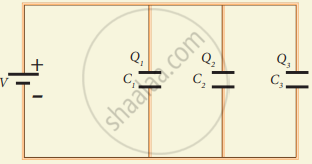
Consider three capacitors of capacitance C1,C2 and C3 connected in parallel with a battery of voltage V as shown in figure (a).
(a) capacitors in parallel-
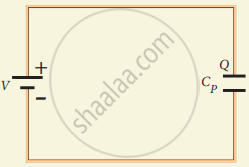
(b) equivalent capacitance with the same total charge
Since corresponding sides of the capacitors are connected to the same positive and negative terminals of the battery, the voltage across each capacitor is equal to the battery’s voltage. Since capacitance of the capacitors is different, the charge stored in each capacitor is not the same. Let the charge stored in the three capacitors be Q1,Q2, and Q2 respectively. According to the law of conservation of total charge, the sum of these three charges is equal to the charge Q transferred by the battery,
Q = Q1 + Q2 + Q3 ….. (1)
Now, since Q = CV, we have
Q = C1V + C2 V + C3 V ….. (2)
If these three capacitors are considered to form a single capacitance CP which stores the total charge Q as shown in figure (b), then we can write Q = CPV. Substituting this in equation (2), we get
Cp V = C1 V + C2 V + C3 V
Cp = C1 + C2 + C3
Thus, the equivalent capacitance of capacitors connected in parallel is equal to the sum of the individual capacitance. The equivalent capacitance Cp in a parallel connection is always greater than the largest individual capacitance. In a parallel connection, it is equivalent as area of each capacitance adds to give more effective area such that total capacitance increases.
APPEARS IN
RELATED QUESTIONS
The capacitance of a capacitor does not depend on
Three capacitors having capacitances 20 µF, 30 µF and 40 µF are connected in series with a 12 V battery. Find the charge on each of the capacitors. How much work has been done by the battery in charging the capacitors?
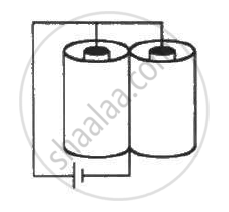
The outer cylinders of two cylindrical capacitors of capacitance 2⋅2 µF each, are kept in contact and the inner cylinders are connected through a wire. A battery of emf 10 V is connected as shown in figure . Find the total charge supplied by the battery to the inner cylinders.
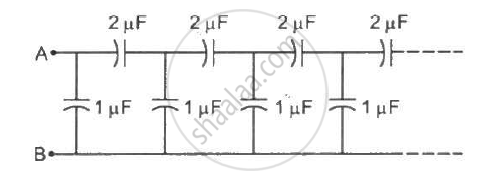
Find the equivalent capacitance of the infinite ladder shown in figure between the points A and B.
A parallel-plate capacitor has plate area 100 cm2 and plate separation 1⋅0 cm. A glass plate (dielectric constant 6⋅0) of thickness 6⋅0 mm and an ebonite plate (dielectric constant 4⋅0) are inserted one over the other to fill the space between the plates of the capacitor. Find the new capacitance.
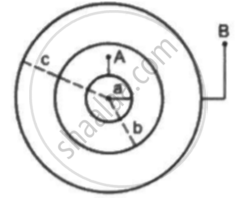
Consider an assembly of three conducting concentric spherical shell of radii a, b and c as shown in figure Find the capacitance of the assembly between the points Aand B.
A parallel plate capacitor stores a charge Q at a voltage V. Suppose the area of the parallel plate capacitor and the distance between the plates are each doubled then which is the quantity that will change?
Between the plates of parallel plate condenser there is 1 mm thick medium shoot of dielectric constant 4. It is charged at 100 volt. The electric field in volt/meter between the plates of capacitor is ______.
Two plates A and B of a parallel plate capacitor are arranged in such a way, that the area of each plate is S = 5 × 10⁻³ m 2 and distance between them is d = 8.85 mm. Plate A has a positive charge q1 = 10-10 C and Plate B has charge q2 = + 2 × 10⁻¹⁰ C. Then the charge induced on the plate B due to the plate A be - (....... × 10-11 )C
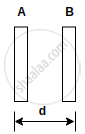
A capacitor with capacitance 5µF is charged to 5 µC. If the plates are pulled apart to reduce the capacitance to 2 µF, how much work is done?
