Advertisements
Advertisements
Question
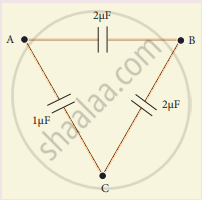
Three capacitors are connected in a triangle as shown in the figure. The equivalent capacitance between points A and C is ______.
Options
1 μF
2 μF
3 μF
`1/4` μF
Advertisements
Solution
Three capacitors are connected in a triangle as shown in the figure. The equivalent capacitance between points A and C is 2 μF.
APPEARS IN
RELATED QUESTIONS
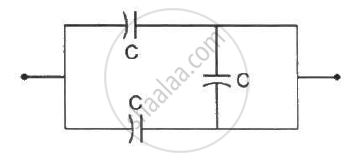
The equivalent capacitance of the combination shown in the figure is _________ .
Suppose, one wishes to construct a 1⋅0 farad capacitor using circular discs. If the separation between the discs be kept at 1⋅0 mm, what would be the radius of the discs?
A parallel-plate capacitor has plate area 25⋅0 cm2 and a separation of 2⋅00 mm between the plates. The capacitor is connected to a battery of 12⋅0 V. (a) Find the charge on the capacitor. (b) The plate separation is decreased to 1⋅00 mm. Find the extra charge given by the battery to the positive plate.
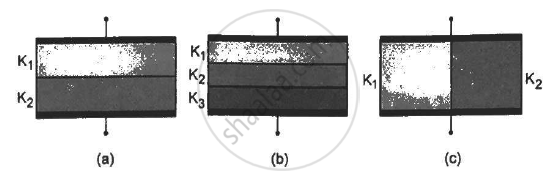
Find the capacitances of the capacitors shown in figure . The plate area is Aand the separation between the plates is d. Different dielectric slabs in a particular part of the figure are of the same thickness and the entire gap between the plates is filled with the dielectric slabs.
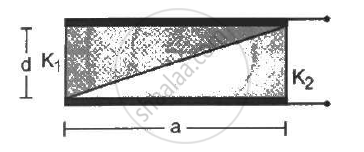
A capacitor is formed by two square metal-plates of edge a, separated by a distance d. Dielectrics of dielectric constant K1 and K2 are filled in the gap as shown in figure . Find the capacitance.
You are provided with 8 μF capacitors. Show with the help of a diagram how you will arrange minimum number of them to get a resultant capacitance of 20 μF.
Obtain the expression for energy stored in the parallel plate capacitor.
The capacitance of a parallel plate capacitor is 60 µF. If the distance between the plates is tripled and area doubled then new capacitance will be ______.
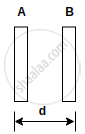
Two plates A and B of a parallel plate capacitor are arranged in such a way, that the area of each plate is S = 5 × 10⁻³ m 2 and distance between them is d = 8.85 mm. Plate A has a positive charge q1 = 10-10 C and Plate B has charge q2 = + 2 × 10⁻¹⁰ C. Then the charge induced on the plate B due to the plate A be - (....... × 10-11 )C
A capacitor of capacity 2 µF is charged to a potential difference of 12 V. It is then connected across an inductor of inductance 0.6 mH. The current in the circuit at a time when the potential difference across the capacitor is 6.0 V is ______ × 10-1A.
