Advertisements
Advertisements
प्रश्न
Derive the expression for resultant capacitance, when the capacitor is connected in parallel.
Advertisements
उत्तर
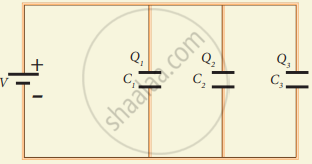
Consider three capacitors of capacitance C1,C2 and C3 connected in parallel with a battery of voltage V as shown in figure (a).
(a) capacitors in parallel-
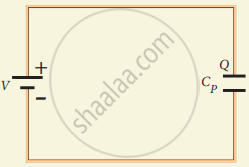
(b) equivalent capacitance with the same total charge
Since corresponding sides of the capacitors are connected to the same positive and negative terminals of the battery, the voltage across each capacitor is equal to the battery’s voltage. Since capacitance of the capacitors is different, the charge stored in each capacitor is not the same. Let the charge stored in the three capacitors be Q1,Q2, and Q2 respectively. According to the law of conservation of total charge, the sum of these three charges is equal to the charge Q transferred by the battery,
Q = Q1 + Q2 + Q3 ….. (1)
Now, since Q = CV, we have
Q = C1V + C2 V + C3 V ….. (2)
If these three capacitors are considered to form a single capacitance CP which stores the total charge Q as shown in figure (b), then we can write Q = CPV. Substituting this in equation (2), we get
Cp V = C1 V + C2 V + C3 V
Cp = C1 + C2 + C3
Thus, the equivalent capacitance of capacitors connected in parallel is equal to the sum of the individual capacitance. The equivalent capacitance Cp in a parallel connection is always greater than the largest individual capacitance. In a parallel connection, it is equivalent as area of each capacitance adds to give more effective area such that total capacitance increases.
APPEARS IN
संबंधित प्रश्न
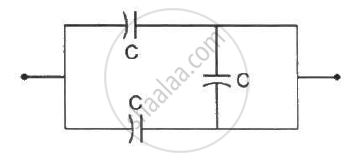
The equivalent capacitance of the combination shown in the figure is _________ .
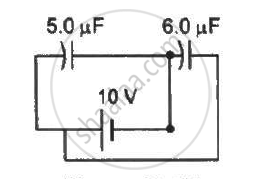
Find the charge supplied by the battery in the arrangement shown in figure.
It is required to construct a 10 µF capacitor which can be connected across a 200 V battery. Capacitors of capacitance 10 µF are available but they can withstand only 50 V. Design a combination which can yield the desired result.
The two square faces of a rectangular dielectric slab (dielectric constant 4⋅0) of dimensions 20 cm × 20 cm × 1⋅0 mm are metal-coated. Find the capacitance between the coated surfaces.
A parallel-plate capacitor of plate area A and plate separation d is charged to a potential difference V and then the battery is disconnected. A slab of dielectric constant K is then inserted between the plates of the capacitor so as to fill the space between the plates. Find the work done on the system in the process of inserting the slab.
You are provided with 8 μF capacitors. Show with the help of a diagram how you will arrange minimum number of them to get a resultant capacitance of 20 μF.
Two similar conducting spheres having charge+ q and -q are placed at 'd' seperation from each other in air. The radius of each ball is r and the separation between their centre is d (d >> r). Calculate the capacitance of the two ball system ______.

A parallel plate capacitor is filled by a dielectric whose relative permittivity varies with the applied voltage (U) as ε = αU where α = 2V–1. A similar capacitor with no dielectric is charged to U0 = 78V. It is then connected to the uncharged capacitor with the dielectric. Find the final voltage on the capacitors.
The material filled between the plates of a parallel plate capacitor has a resistivity of 200Ωm. The value of the capacitance of the capacitor is 2 pF. If a potential difference of 40V is applied across the plates of the capacitor, then the value of leakage current flowing out of the capacitor is ______.
(given the value of relative permittivity of a material is 50.)
A 5µF capacitor is charged fully by a 220 V supply. It is then disconnected from the supply and is connected in series to another uncharged 2.5 µF capacitor If the energy change during the charge redistribution is `"X"/100`J then value of X to the 100 nearest integer is ______.
