Advertisements
Advertisements
Question
Read the following paragraph and answer the questions.
| A capacitor is a system of two conductors separated by an insulator. The two conductors have equal and opposite charges with a potential difference between them. The capacitance of a capacitor depends on the geometrical configuration (shape, size and separation) of the system and also on the nature of the insulator separating the two conductors. They are used to store charges. Like resistors, capacitors can be arranged in series or parallel or a combination of both to obtain the desired value of capacitance. |
- Find the equivalent capacitance between points A and B in the given diagram.

- A dielectric slab is inserted between the plates of the parallel plate capacitor. The electric field between the plates decreases. Explain.
- A capacitor A of capacitance C, having charge Q is connected across another uncharged capacitor B of capacitance 2C. Find an expression for (a) the potential difference across the combination and (b) the charge lost by capacitor A.
OR
Two slabs of dielectric constants 2K and K fill the space between the plates of a parallel plate capacitor of plate area A and plate separation d as shown in the figure. Find an expression for the capacitance of the system.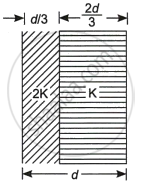
Advertisements
Solution
- The given circuit can be redrawn as it is a balanced Wheatstone bridge.
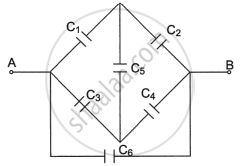
i.e., `C_1/C_2 = C_3/C_4 = C/C = 1/1`
So, Cs can be neglected.
So, the equivalent capacitance between A and B,
`C_{eq} = ((1 xx 1)/(1 + 1) + (1 xx 1)/(1 + 1) + 1)C = 2C` - Total charge of the capacitor remains conserved on the introduction of a dielectric slab. Also, the capacitance of the capacitor increases to K time of its original value.
∴ CV = C'V = KC.V (since Q = Q')
⇒ `V = V/K`
Now electric field,
`E = V/d = ((V"/"K))/d`
= `(V/d)(1/K) = E/K`
So, on introducing a dielectric medium.
The electric field reduces by `(1/K)` times its original value. - (a) The initial charge on capacitor Q = CV.
This capacitor gets connected to another parallel. So total capacitance will be
C' = C + 2C = 3C
The potential difference across this combination will be VC·
`V_C = Q/C^' = Q/(3C)`
As both the capacitors are connected in parallel, therefore, the voltage of both will be the same.
(b) Charges on both capacitors,
`Q_A = CV_C = C. Q/(3C) = Q/3`
`Q_B = 2CV_C = 2C. Q/(3C) = 2/3Q`
∴ Charge lost by capacitor A = `1/3Q`
OR
The effective capacitance in series,
C = `(Kepsi_0A)/d`
C = `(C_1C_2)/(C_1 + C_2)`
`C_1 = (2Kepsi_0A)/(d"/"3), C_2 = (Kepsi_0A)/(2d"/"3)`
C = `(C_1C_2)/(C_1 + C_2)`
= `(((2Kepsi_0A xx 3)/d) ((3Kepsi_0A)/(2d)))/((Kepsi_0A)/d(6 + 3/2))`
= `(9Kepsi_0A xx 2)/(15d)`
= `(6Kepsi_0A)/(5d)`
APPEARS IN
RELATED QUESTIONS
A capacitor has capacitance C. Is this information sufficient to know what maximum charge the capacitor can contain? If yes, what is this charges? If no, what other information is needed?
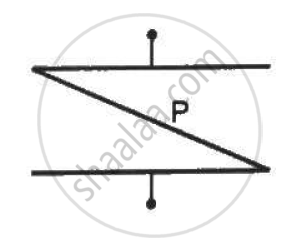
A thin metal plate P is inserted between the plates of a parallel-plate capacitor of capacitance C in such a way that its edges touch the two plates . The capacitance now becomes _________ .
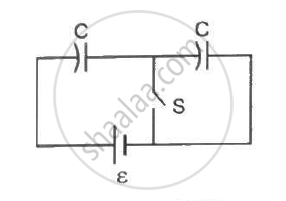
Consider the situation shown in the figure. The switch S is open for a long time and then closed. (a) Find the charge flown through the battery when the switch S is closed. (b) Find the work done by the battery.(c) Find the change in energy stored in the capacitors.(d) Find the heat developed in the system.
The two square faces of a rectangular dielectric slab (dielectric constant 4⋅0) of dimensions 20 cm × 20 cm × 1⋅0 mm are metal-coated. Find the capacitance between the coated surfaces.
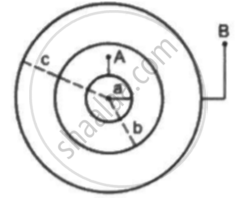
Consider an assembly of three conducting concentric spherical shell of radii a, b and c as shown in figure Find the capacitance of the assembly between the points Aand B.
The variation of inductive reactance (XL) of an inductor with the frequency (f) of the ac source of 100 V and variable frequency is shown in fig.
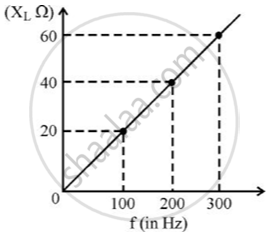
- Calculate the self-inductance of the inductor.
- When this inductor is used in series with a capacitor of unknown value and a resistor of 10 Ω at 300 s–1, maximum power dissipation occurs in the circuit. Calculate the capacitance of the capacitor.
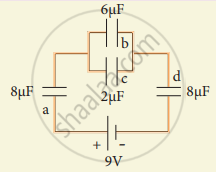
For the given capacitor configuration
- Find the charges on each capacitor
- potential difference across them
- energy stored in each capacitor.
Can the potential function have a maximum or minimum in free space?
The material filled between the plates of a parallel plate capacitor has a resistivity of 200Ωm. The value of the capacitance of the capacitor is 2 pF. If a potential difference of 40V is applied across the plates of the capacitor, then the value of leakage current flowing out of the capacitor is ______.
(given the value of relative permittivity of a material is 50.)
What does a large capacitance mean in terms of charge storage and potential difference?
