Advertisements
Advertisements
Question
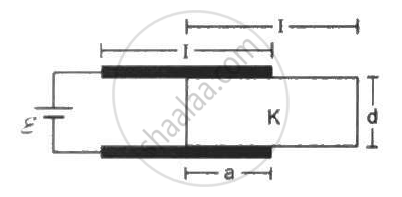
Consider the situation shown in figure. The plates of the capacitor have plate area A and are clamped in the laboratory. The dielectric slab is released from rest with a length a inside the capacitor. Neglecting any effect of friction or gravity, show that the slab will execute periodic motion and find its time period.
Advertisements
Solution
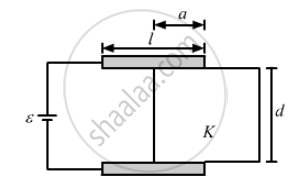
Given that the area of the plates of the capacitors is A.
As ''a'' length of the dielecric slab is inside the capacitor.
Therefore, the area of the plate covered with dielectric is `= A/la`
The capacitance of the portion with dielectric is given by `C_1 = (K∈_0Aa)/(ld)`
The capacitance of the portion without dielectric is given by `C_1 = (∈_0A(l-a))/(ld)`
The two parts can be considered to be in parallel.
Therefore, the net capacitance is given by
`C = C_1 + C_2`
`⇒ C = (∈_0A)/(ld)[Ka + (l-a)]`
`⇒ C = (∈_0A)/(ld)[l + a(K-1)]`
Let us consider a small displacement da of the slab in the inward direction. The capacitance will increase, therefore the energy of the capacitor will also increase. In order to maintain constant voltage, the battery will supply extra charges, therefore the battery will do work.
Work done by the battery = change in energy of capacitor + work done by the force F on the capacitor
`dW_B = dU + dW_F`
Let the charge dq is supplied by the battery, and the change in the capacitor be dC
`dW_B = (dq).V = (dC).V^2`
`dU = 1/2(dC).V^2`
`(dC).V^2 = 1/2(dC).V^2 + F.da`
`1/2(dC).V^2 = F.da`
`⇒ F = 1/2 (dC)/(da)V^2`
`⇒ F = 1/2 d/(da) ((∈_0A)/(ld)[l + a(K-1)])V^2`
`⇒ F = 1/2 (∈_0A)/(ld) (K - 1)`
The acceleration of the dielectric is given by `a_0 = 1/2 (∈_0A)/(ldm)(K-1)`
As, the force is in inward direction, it will tend to make the dielectric to completely fill the space inside the capacitors. As, the dielectric completely fills the space inside the capacitor at this instant its velocity is not zero. The dielectric slab tends to move outside the capacitor. As the slab tends to move out, the direction of the force due to the capacitor will reverse its direction. Thus, the dielectric slab will have a periodic motion.
The time taken to move distance `(l-a)` can be calculated as :-
`(l - a) = 1/2 a_0t^2`
`t = sqrt ((2(l-a))/(a_0))`
`t = sqrt (2(l-a) xx (2ldm)/(∈_0AV^2(K-1))`
`t = sqrt ((4m(l-a)ld)/(∈_0AV^2(K-1))`
For the complete cycle the time period will be four times the time taken for covering distance `(l-a)`.
It is given by :-
`T = 4t = 4 xx 2 sqrt((m(l-a)ld)/(∈_0AV^2(K-1))) = 8 sqrt ((m(l-a)ld)/(∈_0AV^2(K-1))`
APPEARS IN
RELATED QUESTIONS
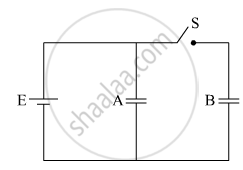
Two identical parallel plate capacitors A and B are connected to a battery of V volts with the switch S closed. The switch is now opened and the free space between the plates of the capacitors is filled with a dielectric of dielectric constant K. Find the ratio of the total electrostatic energy stored in both capacitors before and after the introduction of the dielectric.
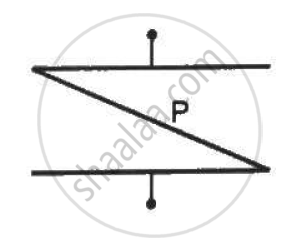
A thin metal plate P is inserted between the plates of a parallel-plate capacitor of capacitance C in such a way that its edges touch the two plates . The capacitance now becomes _________ .
Following operations can be performed on a capacitor:
X − connect the capacitor to a battery of emf ε.
Y − disconnect the battery.
Z − reconnect the battery with polarity reversed.
W − insert a dielectric slab in the capacitor.
(a) In XYZ (perform X, then Y, then Z) the stored electric energy remains unchanged and no thermal energy is developed.
(b) The charge appearing on the capacitor is greater after the action XWY than after the action XYZ.
(c) The electric energy stored in the capacitor is greater after the action WXY than after the action XYW.
(d) The electric field in the capacitor after the action XW is the same as that after WX.
The plates of a parallel-plate capacitor are made of circular discs of radii 5⋅0 cm each. If the separation between the plates is 1⋅0 mm, what is the capacitance?
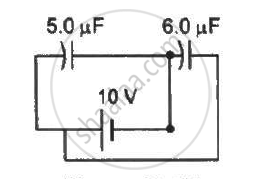
Find the charge supplied by the battery in the arrangement shown in figure.
It is required to construct a 10 µF capacitor which can be connected across a 200 V battery. Capacitors of capacitance 10 µF are available but they can withstand only 50 V. Design a combination which can yield the desired result.
A cylindrical capacitor is constructed using two coaxial cylinders of the same length 10 cm and of radii 2 mm and 4 mm. (a) Calculate the capacitance. (b) Another capacitor of the same length is constructed with cylinders of radii 4 mm and 8 mm. Calculate the capacitance.
A parallel-plate capacitor of capacitance 5 µF is connected to a battery of emf 6 V. The separation between the plates is 2 mm. (a) Find the charge on the positive plate. (b) Find the electric field between the plates. (c) A dielectric slab of thickness 1 mm and dielectric constant 5 is inserted into the gap to occupy the lower half of it. Find the capacitance of the new combination. (d) How much charge has flown through the battery after the slab is inserted?
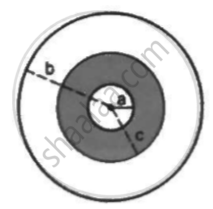
A sphercial capacitor is made of two conducting spherical shells of radii a and b. The space between the shells is filled with a dielectric of dielectric constant K up to a radius c as shown in figure . Calculate the capacitance.
Three capacitors C1 = 3μF, C2 = 6μF, and C3 = 10μF are connected to a 50 V battery as shown in Figure below:

Calculate:
(i) The equivalent capacitance of the circuit between points A and B.
(ii) The charge on C1.
Derive the expression for resultant capacitance, when the capacitor is connected in parallel.
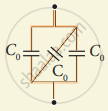
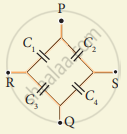
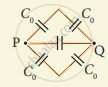
Calculate the resultant capacitances for each of the following combinations of capacitors.
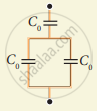
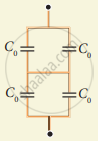
The displacement current of 4.425 µA is developed in the space between the plates of the parallel plate capacitor when voltage is changing at a rate of 106 Vs-1. The area of each plate of the capacitor is 40 cm2. The distance between each plate of the capacitor is x × 10-3 m. The value of x is ______.
(Permittivity of free space, ε0 = 8.85 × 10⁻¹²C2N-1m-2).
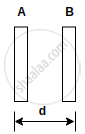
Two plates A and B of a parallel plate capacitor are arranged in such a way, that the area of each plate is S = 5 × 10⁻³ m 2 and distance between them is d = 8.85 mm. Plate A has a positive charge q1 = 10-10 C and Plate B has charge q2 = + 2 × 10⁻¹⁰ C. Then the charge induced on the plate B due to the plate A be - (....... × 10-11 )C
A capacitor of capacity 2 µF is charged to a potential difference of 12 V. It is then connected across an inductor of inductance 0.6 mH. The current in the circuit at a time when the potential difference across the capacitor is 6.0 V is ______ × 10-1A.
Which system is called a capacitor?
What is the SI unit of capacitance?
For a given capacitor, what fixes its capacitance?
In a series combination, which quantity is the same on each capacitor?
