Advertisements
Advertisements
Questions
Obtain the expression for capacitance for a parallel plate capacitor.
Derive an expression for the capacitance of a parallel plate capacitor with air present between the two plates.
Advertisements
Solution 1
Consider a capacitor with two parallel plates each of cross-sectional area A and separated by a distance d. The electric field between two infinite parallel plates is uniform and is given by E = `sigma/ε_0` where σ is the surface charge density on the plates σ = `"Q"/"A"`. If the separation distance d is very much smaller than the size of the plate (d2 << A), then the above result is used even for finite-sized
parallel plate capacitor.

Capacitance of a parallel plate capacitor
Capacitance of a parallel plate capacitor
The electric field between the plates is
E = `"Q"/("A"ε_0)` ....(1)
Since the electric field is unifonn, the electric potential between the plates having separation d is given by
V = Ed = `"Qd"/("A"ε_0)` ....(2)
Therefore the capacitance of the capacitor is given by
C = `"Q"/"V" = "Q"/(("Qd"/("A"ε_0))) = (ε_0"A")/"d"` ....(3)
From equation (3), it is evident that capacitance is directly proportional to the area of cross-section and is inversely proportional to the distance between the plates. This can be understood from the following.
- If the area of cross-section of the capacitor plates is increased, more charges can be distributed for the same potential difference. As a result, the capacitance is increased.
- If the distance d between the two plates is reduced, the potential difference between the plates (V = Ed) decreases with E constant.
Solution 2
Derivation of the expression for the capacitance.
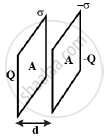
Let the two plates be kept parallel to each other separated by a distance d and the cross-sectional area of each plate is A. Electric field by a single thin plate E = `sigma/(2epsi_0)`
The total electric field between the plates E = `sigma/epsi_0` = `Q/(Aepsi_0)`
The potential difference between the plates V = Ed = `[Q/(Aε_0)]`d.
Capacitance C = `"Q"/"V" = (Aepsi_0)/d`
RELATED QUESTIONS
A capacitor of capacitance ‘C’ is charged to ‘V’ volts by a battery. After some time the battery is disconnected and the distance between the plates is doubled. Now a slab of dielectric constant, 1 < k < 2, is introduced to fill the space between the plates. How will the following be affected? (a) The electric field between the plates of the capacitor Justify your answer by writing the necessary expressions.
Three capacitors of capacitances 6 µF each are available. The minimum and maximum capacitances, which may be obtained are
The capacitance of a capacitor does not depend on
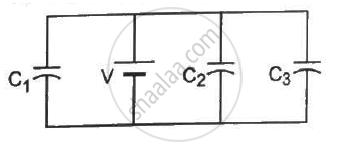
Find the charges on the three capacitors connected to a battery as shown in figure.
Take `C_1 = 2.0 uF , C_2 = 4.0 uF , C_3 = 6.0 uF and V` = 12 volts.
Three capacitors having capacitances 20 µF, 30 µF and 40 µF are connected in series with a 12 V battery. Find the charge on each of the capacitors. How much work has been done by the battery in charging the capacitors?
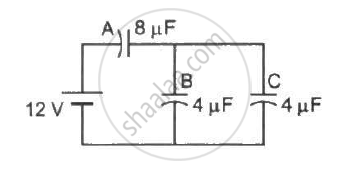
Find the charge appearing on each of the three capacitors shown in figure .
It is required to construct a 10 µF capacitor which can be connected across a 200 V battery. Capacitors of capacitance 10 µF are available but they can withstand only 50 V. Design a combination which can yield the desired result.
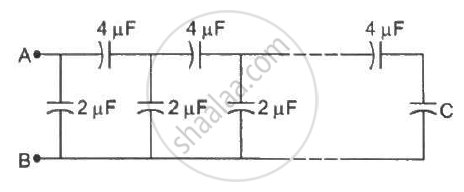
A finite ladder is constructed by connecting several sections of 2 µF, 4 µF capacitor combinations as shown in the figure. It is terminated by a capacitor of capacitance C. What value should be chosen for C, such that the equivalent capacitance of the ladder between the points A and B becomes independent of the number of sections in between?
A parallel-plate capacitor of capacitance 5 µF is connected to a battery of emf 6 V. The separation between the plates is 2 mm. (a) Find the charge on the positive plate. (b) Find the electric field between the plates. (c) A dielectric slab of thickness 1 mm and dielectric constant 5 is inserted into the gap to occupy the lower half of it. Find the capacitance of the new combination. (d) How much charge has flown through the battery after the slab is inserted?
A parallel-plate capacitor has plate area 100 cm2 and plate separation 1⋅0 cm. A glass plate (dielectric constant 6⋅0) of thickness 6⋅0 mm and an ebonite plate (dielectric constant 4⋅0) are inserted one over the other to fill the space between the plates of the capacitor. Find the new capacitance.
A parallel plate capacitor stores a charge Q at a voltage V. Suppose the area of the parallel plate capacitor and the distance between the plates are each doubled then which is the quantity that will change?
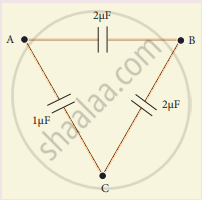
Three capacitors are connected in a triangle as shown in the figure. The equivalent capacitance between points A and C is ______.
Between the plates of parallel plate condenser there is 1 mm thick medium shoot of dielectric constant 4. It is charged at 100 volt. The electric field in volt/meter between the plates of capacitor is ______.
Obtain the equivalent capacitance of the network shown in the figure. For a 300 V supply, determine the charge on each capacitor.

If the plates of a parallel plate capacitor connected to a battery are moved close to each other, then:
- the charge stored in it. increases.
- the energy stored in it, decreases.
- its capacitance increases.
- the ratio of charge to its potential remains the same.
- the product of charge and voltage increases.
Choose the most appropriate answer from the options given below:
Which statement lists the factors on which capacitance depends?
For a given capacitor, what fixes its capacitance?
What is the practical purpose of a series combination of capacitors?
What is the practical purpose of a parallel combination of capacitors?
