Advertisements
Advertisements
Question
A capacitor with stored energy 4⋅0 J is connected with an identical capacitor with no electric field in between. Find the total energy stored in the two capacitors.
Advertisements
Solution
Given :
Energy stored in the charged capacitor = 4.0 J
When the capacitors are connected, the charge flows from the charged capacitor to the uncharged capacitor. Because the capacitors are identical, the charge flows till the charge in both the capacitors becomes equal.
The energy of a capacitor is given by `E = q^2/(2C)`
As the charge in both the capacitors is the same, their capacitance is also the same. So, the energy is equally divided between them.
Thus, the energy stored in each of the capacitors is 2.0 J.
APPEARS IN
RELATED QUESTIONS
Obtain the expression for the energy stored per unit volume in a charged parallel plate capacitor.
The energy density in the electric field created by a point charge falls off with the distance from the point charge as
Two capacitors of capacitances 4⋅0 µF and 6⋅0 µF are connected in series with a battery of 20 V. Find the energy supplied by the battery.
A capacitance C charged to a potential difference V is discharged by connecting its plates through a resistance R. Find the heat dissipated in one time constant after the connections are made. Do this by calculating ∫ i2R dt and also by finding the decrease in the energy stored in the capacitor.
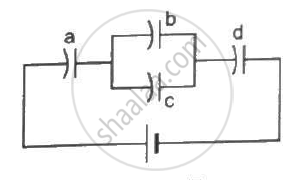
Each capacitor in figure has a capacitance of 10 µF. The emf of the battery is 100 V. Find the energy stored in each of the four capacitors.
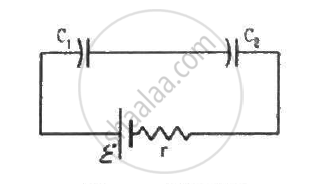
Consider the situation shown in figure. The switch is closed at t = 0 when the capacitors are uncharged. Find the charge on the capacitor C1 as a function of time t.
A capacitor of capacitance C is given a charge Q. At t = 0, it is connected to an ideal battery of emf ε through a resistance R. Find the charge on the capacitor at time t.
A metal sphere of radius R is charged to a potential V.
- Find the electrostatic energy stored in the electric field within a concentric sphere of radius 2 R.
- Show that the electrostatic field energy stored outside the sphere of radius 2 R equals that stored within it.
A capacitor is a device that stores ____________.
A parallel plate capacitor has a uniform electric field ‘`vec "E"`’ in the space between the plates. If the distance between the plates is ‘d’ and the area of each plate is ‘A’, the energy stored in the capacitor is ______
(ε0 = permittivity of free space)
A parallel plate capacitor has a uniform electric field `overset(->)("E")` in the space between the plates. If the distance between the plates is ‘d’ and the area of each plate is ‘A’, the energy stored in the capacitor is ______
(ε0 = permittivity of free space)
Do free electrons travel to region of higher potential or lower potential?
Electrostatic energy of 4 x 10⁻⁴ J is stored in a charged 25 pF capacitor. Find the charge on the capacitor.
What is called the energy stored in a capacitor?
Which expression gives the work done in transferring charge \(q\) through potential difference \(V\) in a capacitor?
Which integral represents the total work done in charging a capacitor from zero charge to final charge \(Q\)?
Evaluating the work integral for charging a capacitor from \(0\) to \(Q\) gives which result?
