Advertisements
Advertisements
Questions
Derive an expression for energy stored in a capacitor.
Derive an expression for energy stored in a charged capacitor.
Advertisements
Solution
Consider a capacitor of capacitance C being charged by a DC source of V volt as shown in figure.
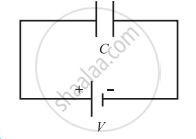
Capacitor charged by a DC source.
During the process of charging, let q' be the charge on the capacitor and V be the potential difference between the plates. Hence
`"C" =("q""'")/"V"`
A small amount of work is done if a small charge dq is further transferred between the plates.
∴ `"dW" ="Vdq"=("q""'")/"Cdq"`
Total work done in transferring the charge
`"W"=int"dw"=int_0^"Q" ("q'")/"C" "dq" = 1/"C"int_0^"Q" "q'" "dq"`
`=1/"C"[(("q""'")^2)/2]_0^"Q" = 1/2 "Q"^2/"C"`
This work done is stored as electrical potential energy U of the capacitor. This work done can be expressed in different forms as follows:
∴ `"U" = 1/2 "Q"^2/"C"=1/2"CV"^2=1/2"QV" (because "Q" = "CV")`
Notes
Students should refer to the answer according to their questions.
APPEARS IN
RELATED QUESTIONS
Explain what would happen if the capacitor given in previous question a 3 mm thick mica sheet (of dielectric constant = 6) were inserted between the plates,
- While the voltage supply remained connected.
- After the supply was disconnected.
A 12 pF capacitor is connected to a 50 V battery. How much electrostatic energy is stored in the capacitor?
A 600 pF capacitor is charged by a 200 V supply. It is then disconnected from the supply and is connected to another uncharged 600 pF capacitor. How much electrostatic energy is lost in the process?
Find the charge on the capacitor as shown in the circuit.
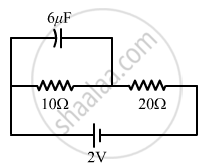
Find the ratio of energy stored in the two configurations if they are both connected to the same source.
The energy density in the electric field created by a point charge falls off with the distance from the point charge as
A capacitor C1 of capacitance 1 μF and a capacitor C2 of capacitance 2 μF are separately charged by a common battery for a long time. The two capacitors are then separately discharged through equal resistors. Both the discharge circuits are connected at t = 0.
(a) The current in each of the two discharging circuits is zero at t = 0.
(b) The currents in the two discharging circuits at t = 0 are equal but not zero.
(c) The currents in the two discharging circuits at t = 0 are unequal.
(d) C1 loses 50% of its initial charge sooner than C2 loses 50% of its initial charge.
How many time constants will elapse before the current in a charging RC circuit drops to half of its initial value? Answer the same question for a discharging RC circuit.
How many time constants will elapse before the charge on a capacitors falls to 0.1% of its maximum value in a discharging RC circuit?
Two capacitors of capacitances 4⋅0 µF and 6⋅0 µF are connected in series with a battery of 20 V. Find the energy supplied by the battery.
A capacitor of capacitance 12.0 μF is connected to a battery of emf 6.00 V and internal resistance 1.00 Ω through resistanceless leads. 12.0 μs after the connections are made, what will be (a) the current in the circuit (b) the power delivered by the battery (c) the power dissipated in heat and (d) the rate at which the energy stored in the capacitor is increasing?
By evaluating ∫i2Rdt, show that when a capacitor is charged by connecting it to a battery through a resistor, the energy dissipated as heat equals the energy stored in the capacitor.
A capacitor of capacitance 100 μF is connected across a battery of emf 6 V through a resistance of 20 kΩ for 4 s. The battery is then replaced by a thick wire. What will be the charge on the capacitor 4 s after the battery is disconnected?
A capacitor of capacitance C is given a charge Q. At t = 0, it is connected to an uncharged capacitor of equal capacitance through a resistance R. Find the charge on the second capacitor as a function of time.
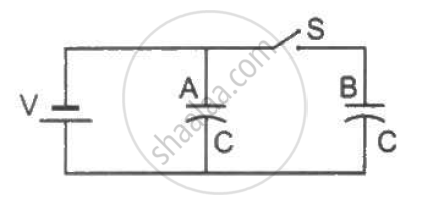
Figure shows two identical parallel plate capacitors connected to a battery through a switch S. Initially, the switch is closed so that the capacitors are completely charged. The switch is now opened and the free space between the plates of the capacitors is filled with a dielectric of dielectric constant 3. Find the ratio of the initial total energy stored in the capacitors to the final total energy stored.
A capacitor is a device that stores ____________.
An air-filled parallel plate capacitor has a uniform electric field `overset(->)("E")` in the space between the plates. If the distance between the plates is 'd' and the area of each plate is 'A', the energy stored in the capacitor is ______
(∈0 = permittivity of free space)
A 2µF capacitor is charge to 100 volt and then its plate are connected by a conducting wire. The heat produced is:-
What fraction of the energy drawn from the charging battery is stored in a capacitor?
Do free electrons travel to region of higher potential or lower potential?
A fully charged capacitor C with initial charge q0 is connected to a coil of self-inductance L at t = 0. The time at which the energy is stored equally between the electric and magnetic fields is ______.
Electrostatic energy of 4 x 10⁻⁴ J is stored in a charged 25 pF capacitor. Find the charge on the capacitor.
In a capacitor of capacitance 20 µF, the distance between the plates is 2 mm. If a dielectric slab of width 1 mm and dielectric constant 2 is inserted between the plates, what is the new capacitance?
What is the SI unit of energy stored in a capacitor?
A capacitor with capacitance \(3\times10^{-9}\,\mathrm{F}\) is connected to \(400\,\mathrm{V}\). A dielectric slab with \(K=3\) completely fills the space, and the voltage is kept constant. What is the energy change when the slab is removed?
