Advertisements
Advertisements
Question
Obtain the expression for the energy stored per unit volume in a charged parallel plate capacitor.
Advertisements
Solution
Let us consider a parallel-plate capacitor of plate area A
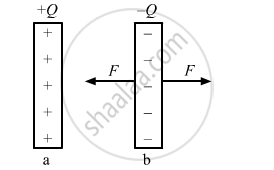
Suppose the plates of the capacitor are almost touching each other and a charge Q is given to the capacitor. One of the plates, say a, is kept fixed and other say b, is slowly pulled away from plate a to increase the separation from zero to d. The attractive force on the plate b at any instant due to first plate is given by:
`F=Q^2/(2Aepsilon_0)`
The person pulling the plate b must apply an equal and opposite force (F) in the opposite direction if the plate is moved slowly.
Work done by the person during the displacement of the second plate:
W = Fd
`=(Q^2d)/(2Aepsilon_0)=Q^2/(2C)`
Here,`C=(Aepsilon_0)/d`, which is the capacitance of the capacitor in the final position.
The work done by the person must be equal to the increase in the energy of the system.
Thus, the capacitor has a stored energy.
`U=Q^2/(2C)`
Now, if we pull the plates of the capacitor apart, we have to do work against the electrostatic attraction between the plates. When we increase the separation between the plates from d1 to d2, an amount `Q^2/(2Aepsilon_0)(d_2-d_1)` of work is performed by us and this much energy goes into the capacitor. On the other hand, new electric field is created in a volume A(d2 - d1).
The energy stored per unit volume is thus given by:
`u=((Q^2(d_2-d_1))/(2Aepsilon_0))/(A(d_2-d_1))=Q^2/(2A^2epsilon_0)`
`1/2epsilon_0(Q/(Aepsilon_0))^2=1/2epsilon_0E^2`
Here, E is the intensity of the electric field.
APPEARS IN
RELATED QUESTIONS
A 12 pF capacitor is connected to a 50 V battery. How much electrostatic energy is stored in the capacitor?
A 20 μF capacitor is joined to a battery of emf 6.0 V through a resistance of 100 Ω. Find the charge on the capacitor 2.0 ms after the connections are made.
A metal sphere of radius R is charged to a potential V.
- Find the electrostatic energy stored in the electric field within a concentric sphere of radius 2 R.
- Show that the electrostatic field energy stored outside the sphere of radius 2 R equals that stored within it.
Obtain the expression for the energy stored in a capacitor connected across a dc battery.
An air-filled parallel plate capacitor has a uniform electric field `overset(->)("E")` in the space between the plates. If the distance between the plates is 'd' and the area of each plate is 'A', the energy stored in the capacitor is ______
(∈0 = permittivity of free space)
A parallel plate capacitor has a uniform electric field ‘`vec "E"`’ in the space between the plates. If the distance between the plates is ‘d’ and the area of each plate is ‘A’, the energy stored in the capacitor is ______
(ε0 = permittivity of free space)
A fully charged capacitor C with initial charge q0 is connected to a coil of self-inductance L at t = 0. The time at which the energy is stored equally between the electric and magnetic fields is ______.
A parallel plate capacitor (A) of capacitance C is charged by a battery to voltage V. The battery is disconnected and an uncharged capacitor (B) of capacitance 2C is connected across A. Find the ratio of total electrostatic energy stored in A and B finally and that stored in A initially.
Derive an expression for energy stored in a capacitor.
Which expression gives the work done in transferring charge \(q\) through potential difference \(V\) in a capacitor?
