Advertisements
Advertisements
Question
The energy density in the electric field created by a point charge falls off with the distance from the point charge as
Options
`1/r`
`1/r^2`
`1/r^3`
`1/r^4`
Advertisements
Solution
`1/r^4`
Energy density U is given by `U = 1/2∈_0E^2`.......(1)
The electric field created by a point charge at a distance r is given by `E = q/(4pi∈_0r^2)`
On putting the above form of E in eq. 1, we get
`U = 1/2 ∈_0(q/(4pi∈_0r_2))^2`
Thus, U is directly proportional to `1/r^4`
APPEARS IN
RELATED QUESTIONS
Explain what would happen if the capacitor given in previous question a 3 mm thick mica sheet (of dielectric constant = 6) were inserted between the plates,
- While the voltage supply remained connected.
- After the supply was disconnected.
A 600 pF capacitor is charged by a 200 V supply. It is then disconnected from the supply and is connected to another uncharged 600 pF capacitor. How much electrostatic energy is lost in the process?
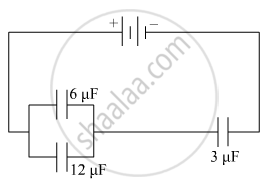
In the following arrangement of capacitors, the energy stored in the 6 µF capacitor is E. Find the value of the following :
(i) Energy stored in 12 µF capacitor.
(ii) Energy stored in 3 µF capacitor.
(iii) Total energy drawn from the battery.
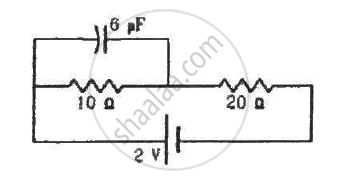
Find the charge on the capacitor shown in the figure.
A 20 μF capacitor is joined to a battery of emf 6.0 V through a resistance of 100 Ω. Find the charge on the capacitor 2.0 ms after the connections are made.
How many time constants will elapse before the energy stored in the capacitor reaches half of its equilibrium value in a charging RC circuit?
By evaluating ∫i2Rdt, show that when a capacitor is charged by connecting it to a battery through a resistor, the energy dissipated as heat equals the energy stored in the capacitor.
A capacitor of capacitance C is given a charge Q. At t = 0, it is connected to an ideal battery of emf ε through a resistance R. Find the charge on the capacitor at time t.
A point charge Q is placed at the origin. Find the electrostatic energy stored outside the sphere of radius R centred at the origin.
If the p. d. across a capacitor is increased from 10 V to 30 V, then the energy stored with the capacitor ____________.
A parallel plate condenser is immersed in an oil of dielectric constant 2. The field between the plates is ______.
A fully charged capacitor C with initial charge q0 is connected to a coil of self-inductance L at t = 0. The time at which the energy is stored equally between the electric and magnetic fields is ______.
Electrostatic energy of 4 x 10⁻⁴ J is stored in a charged 25 pF capacitor. Find the charge on the capacitor.
In a capacitor of capacitance 20 µF, the distance between the plates is 2 mm. If a dielectric slab of width 1 mm and dielectric constant 2 is inserted between the plates, what is the new capacitance?
Which integral represents the total work done in charging a capacitor from zero charge to final charge \(Q\)?
Evaluating the work integral for charging a capacitor from \(0\) to \(Q\) gives which result?
What is the energy density of the electric field for a parallel-plate capacitor?
A capacitor with capacitance \(3\times10^{-9}\,\mathrm{F}\) is connected to \(400\,\mathrm{V}\). A dielectric slab with \(K=3\) completely fills the space, and the voltage is kept constant. What is the energy change when the slab is removed?
