Advertisements
Advertisements
Question
A capacitance C charged to a potential difference V is discharged by connecting its plates through a resistance R. Find the heat dissipated in one time constant after the connections are made. Do this by calculating ∫ i2R dt and also by finding the decrease in the energy stored in the capacitor.
Advertisements
Solution 1
Let Q0 be the initial charge on the capacitor. Then,
Q0 = CV
The charge on the capacitor at time t after the connections are made,
\[Q = Q_0 e^{- \frac{t}{RC}}\]
\[i = \frac{dQ}{dt} = - \left( \frac{Q_0}{RC} \right) e^{- \frac{t}{RC}}\]
Heat dissipated during time t1 to t2,
\[U = \int_{t_1}^{t_2} i^2 Rdt\]
\[ = \frac{{Q_0}^2}{2C}\left( e^{- \frac{2 t_1}{RC}} - e^{- \frac{2 t_2}{RC}} \right)\]
Time constant = RC
Putting t1 = 0 and t2 = RC, we get:-
\[U = \frac{{Q_0}^2}{2C}\left( e^{- 0} - e^{- 2} \right)\]
\[ \because Q_0 = CV, \]
\[ U = \frac{CV^2}{2}\left( 1 - \frac{1}{e^2} \right)\]
Solution 2
Heat dissipated at any time = Energy stored at time 0 − Energy stored at time t
\[\Rightarrow U = \frac{1}{2}C V^2 - \frac{1}{2}C V^2 e^{- \frac{2t}{RC}} \]
\[ \because t = RC, \]
\[ U = \frac{1}{2}C V^2 - \frac{1}{2}C V^2 e^{- 2} \]
\[ \Rightarrow U = \frac{1}{2}C V^2 \left( 1 - \frac{1}{e^2} \right)\]
APPEARS IN
RELATED QUESTIONS
A 12 pF capacitor is connected to a 50 V battery. How much electrostatic energy is stored in the capacitor?
A capacitor of capacitance 12.0 μF is connected to a battery of emf 6.00 V and internal resistance 1.00 Ω through resistanceless leads. 12.0 μs after the connections are made, what will be (a) the current in the circuit (b) the power delivered by the battery (c) the power dissipated in heat and (d) the rate at which the energy stored in the capacitor is increasing?
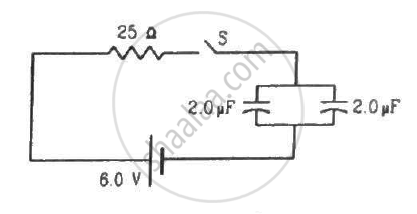
Find the charge on each of the capacitors 0.20 ms after the switch S is closed in the figure.
Consider the situation shown in figure. The switch is closed at t = 0 when the capacitors are uncharged. Find the charge on the capacitor C1 as a function of time t.
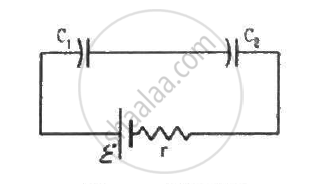
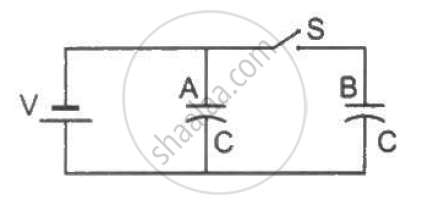
Figure shows two identical parallel plate capacitors connected to a battery through a switch S. Initially, the switch is closed so that the capacitors are completely charged. The switch is now opened and the free space between the plates of the capacitors is filled with a dielectric of dielectric constant 3. Find the ratio of the initial total energy stored in the capacitors to the final total energy stored.
A capacitor is a device that stores ____________.
A capacitor is charged by a battery and energy stored is 'U'. Now the battery is removed and the distance between plates is increased to four times. The energy stored becomes ______.
An air-filled parallel plate capacitor has a uniform electric field `overset(->)("E")` in the space between the plates. If the distance between the plates is 'd' and the area of each plate is 'A', the energy stored in the capacitor is ______
(∈0 = permittivity of free space)
What fraction of the energy drawn from the charging battery is stored in a capacitor?
A parallel plate capacitor has a uniform electric field ‘`vec "E"`’ in the space between the plates. If the distance between the plates is ‘d’ and the area of each plate is ‘A’, the energy stored in the capacitor is ______
(ε0 = permittivity of free space)
Do free electrons travel to region of higher potential or lower potential?
A parallel plate capacitor (A) of capacitance C is charged by a battery to voltage V. The battery is disconnected and an uncharged capacitor (B) of capacitance 2C is connected across A. Find the ratio of total electrostatic energy stored in A and B finally and that stored in A initially.
In a capacitor of capacitance 20 µF, the distance between the plates is 2 mm. If a dielectric slab of width 1 mm and dielectric constant 2 is inserted between the plates, what is the new capacitance?
What is called the energy stored in a capacitor?
Which set gives the equivalent expressions for the energy stored in a capacitor?
If an additional small charge \(dq\) is supplied to a capacitor when its potential difference is \(V\), what is the small work done?
Which integral represents the total work done in charging a capacitor from zero charge to final charge \(Q\)?
Evaluating the work integral for charging a capacitor from \(0\) to \(Q\) gives which result?
