Advertisements
Advertisements
Question
Two capacitors of capacitances 4⋅0 µF and 6⋅0 µF are connected in series with a battery of 20 V. Find the energy supplied by the battery.
Advertisements
Solution
Given :
`C_1 = 4 "uF"`
`C_2 = 6 "uF"`
`V = 20 V`
Now,
The equivalent capacitance is given by
`C_(eq) =( C_1C_2)/(C_1+C_2) = (4 xx 6)/(4+6) = 2.4 "uF"`
The energy supplied by the battery is given by
`E = C_(eq) V^2`
= `(2.4 "uF") xx (20)^2`
= `(2.4 "uF") xx 400 = 960 "uJ"`
APPEARS IN
RELATED QUESTIONS
Obtain the expression for the energy stored per unit volume in a charged parallel plate capacitor.
Explain what would happen if the capacitor given in previous question a 3 mm thick mica sheet (of dielectric constant = 6) were inserted between the plates,
- While the voltage supply remained connected.
- After the supply was disconnected.
A capacitor of capacitance 500 μF is connected to a battery through a 10 kΩ resistor. The charge stored in the capacitor in the first 5 s is larger than the charge stored in the next.
(a) 5 s
(b) 50 s
(c) 500 s
(d) 500 s
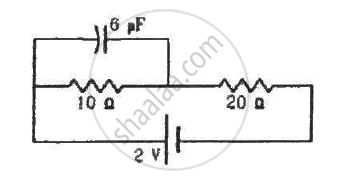
Find the charge on the capacitor shown in the figure.
A 20 μF capacitor is joined to a battery of emf 6.0 V through a resistance of 100 Ω. Find the charge on the capacitor 2.0 ms after the connections are made.
How many time constants will elapse before the current in a charging RC circuit drops to half of its initial value? Answer the same question for a discharging RC circuit.
A capacitance C charged to a potential difference V is discharged by connecting its plates through a resistance R. Find the heat dissipated in one time constant after the connections are made. Do this by calculating ∫ i2R dt and also by finding the decrease in the energy stored in the capacitor.
By evaluating ∫i2Rdt, show that when a capacitor is charged by connecting it to a battery through a resistor, the energy dissipated as heat equals the energy stored in the capacitor.
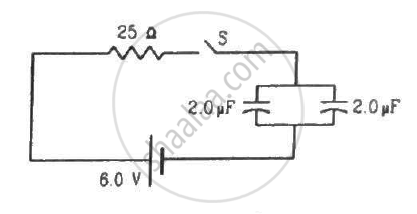
Find the charge on each of the capacitors 0.20 ms after the switch S is closed in the figure.
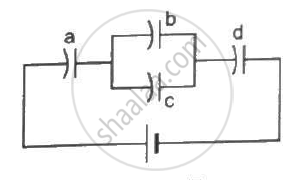
Each capacitor in figure has a capacitance of 10 µF. The emf of the battery is 100 V. Find the energy stored in each of the four capacitors.
A capacitor is a device that stores ____________.
An air-filled parallel plate capacitor has a uniform electric field `overset(->)("E")` in the space between the plates. If the distance between the plates is 'd' and the area of each plate is 'A', the energy stored in the capacitor is ______
(∈0 = permittivity of free space)
A 2µF capacitor is charge to 100 volt and then its plate are connected by a conducting wire. The heat produced is:-
What fraction of the energy drawn from the charging battery is stored in a capacitor?
A fully charged capacitor C with initial charge q0 is connected to a coil of self-inductance L at t = 0. The time at which the energy is stored equally between the electric and magnetic fields is ______.
A parallel plate capacitor (A) of capacitance C is charged by a battery to voltage V. The battery is disconnected and an uncharged capacitor (B) of capacitance 2C is connected across A. Find the ratio of total electrostatic energy stored in A and B finally and that stored in A initially.
Evaluating the work integral for charging a capacitor from \(0\) to \(Q\) gives which result?
Using \(Q=CV\), which expression is an equivalent form of \(U=\frac{Q^2}{2C}\)?
A capacitor with capacitance \(3\times10^{-9}\,\mathrm{F}\) is connected to \(400\,\mathrm{V}\). A dielectric slab with \(K=3\) completely fills the space, and the voltage is kept constant. What is the energy change when the slab is removed?
