Advertisements
Advertisements
प्रश्न
Two capacitors of capacitances 4⋅0 µF and 6⋅0 µF are connected in series with a battery of 20 V. Find the energy supplied by the battery.
Advertisements
उत्तर
Given :
`C_1 = 4 "uF"`
`C_2 = 6 "uF"`
`V = 20 V`
Now,
The equivalent capacitance is given by
`C_(eq) =( C_1C_2)/(C_1+C_2) = (4 xx 6)/(4+6) = 2.4 "uF"`
The energy supplied by the battery is given by
`E = C_(eq) V^2`
= `(2.4 "uF") xx (20)^2`
= `(2.4 "uF") xx 400 = 960 "uJ"`
APPEARS IN
संबंधित प्रश्न
Explain what would happen if the capacitor given in previous question a 3 mm thick mica sheet (of dielectric constant = 6) were inserted between the plates,
- While the voltage supply remained connected.
- After the supply was disconnected.
A capacitor of capacitance 500 μF is connected to a battery through a 10 kΩ resistor. The charge stored in the capacitor in the first 5 s is larger than the charge stored in the next.
(a) 5 s
(b) 50 s
(c) 500 s
(d) 500 s
A capacitance C, a resistance R and an emf ε are connected in series at t = 0. What is the maximum value of (a) the potential difference across the resistor (b) the current in the circuit (c) the potential difference across the capacitor (d) the energy stored in the capacitor (e) the power delivered by the battery and (f) the power converted into heat?
How many time constants will elapse before the energy stored in the capacitor reaches half of its equilibrium value in a charging RC circuit?
By evaluating ∫i2Rdt, show that when a capacitor is charged by connecting it to a battery through a resistor, the energy dissipated as heat equals the energy stored in the capacitor.
Find the charge on each of the capacitors 0.20 ms after the switch S is closed in the figure.
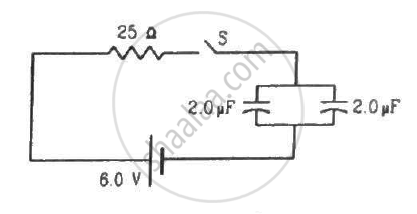
A capacitor of capacitance 100 μF is connected across a battery of emf 6 V through a resistance of 20 kΩ for 4 s. The battery is then replaced by a thick wire. What will be the charge on the capacitor 4 s after the battery is disconnected?
A capacitor of capacitance C is given a charge Q. At t = 0, it is connected to an ideal battery of emf ε through a resistance R. Find the charge on the capacitor at time t.
Choose the correct option:
Energy stored in a capacitor and dissipated during charging a capacitor bear a ratio.
A parallel plate condenser is immersed in an oil of dielectric constant 2. The field between the plates is ______.
An air-filled parallel plate capacitor has a uniform electric field `overset(->)("E")` in the space between the plates. If the distance between the plates is 'd' and the area of each plate is 'A', the energy stored in the capacitor is ______
(∈0 = permittivity of free space)
A 2µF capacitor is charge to 100 volt and then its plate are connected by a conducting wire. The heat produced is:-
What fraction of the energy drawn from the charging battery is stored in a capacitor?
A parallel plate capacitor has a uniform electric field ‘`vec "E"`’ in the space between the plates. If the distance between the plates is ‘d’ and the area of each plate is ‘A’, the energy stored in the capacitor is ______
(ε0 = permittivity of free space)
A parallel plate capacitor has a uniform electric field `overset(->)("E")` in the space between the plates. If the distance between the plates is ‘d’ and the area of each plate is ‘A’, the energy stored in the capacitor is ______
(ε0 = permittivity of free space)
Derive an expression for energy stored in a capacitor.
If the charge on the parallel plate capacitor is increased by 3 C, the energy stored in it increases by 44%. The original charge on the capacitor is ______.
What is the SI unit of energy stored in a capacitor?
Evaluating the work integral for charging a capacitor from \(0\) to \(Q\) gives which result?
