Advertisements
Advertisements
प्रश्न
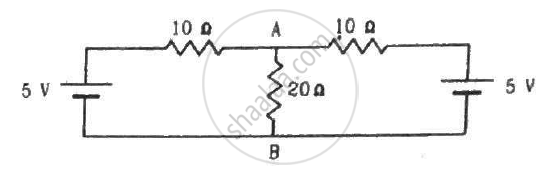
(a) Find the current in the 20 Ω resistor shown in the figure. (b) If a capacitor of capacitance 4 μF is joined between the points A and B, what would be the electrostatic energy stored in it in steady state?
Advertisements
उत्तर
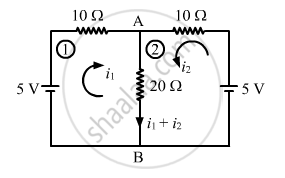
(a) Applying Kirchoff's voltage law in loop 1, we get:
In the circuit ABEDA,
10i1 + 20 (i1 + i2) − 5 = 0
⇒ 30i1 + 20i2 = 5 ............(1)
Applying Kirchoff's voltage law in loop 2, we get:-
20 (i1 + i2) − 5 + 10i2 = 0
⇒ 20i1 + 30i2 = 5 ...........(2)
Multiplying equation (1) by 20 and (2) by 30 and subtracting (2) from (1), we get:-
i2 = 0.1 A
and i1 = 0.1 A
∴ Current through the 20 Ω resistor = i1 + i2 = 0.1 + 0.1 = 0.2 A
(b) Potential drop across across AB is,
\[V_{AB} = 0 . 2 \times 20 = 4 V\]
Electrostatic energy stored in the capacitor is given by,
\[U = \frac{1}{2}C {V_{AB}}^2 \]
\[U = \frac{1}{2} \times 4 \times {10}^{- 6} \times (0 . 2 \times 20 )^2 \]
\[U = 32 \times {10}^{- 6} J\]
APPEARS IN
संबंधित प्रश्न
The energy density in the electric field created by a point charge falls off with the distance from the point charge as
A capacitor C1 of capacitance 1 μF and a capacitor C2 of capacitance 2 μF are separately charged by a common battery for a long time. The two capacitors are then separately discharged through equal resistors. Both the discharge circuits are connected at t = 0.
(a) The current in each of the two discharging circuits is zero at t = 0.
(b) The currents in the two discharging circuits at t = 0 are equal but not zero.
(c) The currents in the two discharging circuits at t = 0 are unequal.
(d) C1 loses 50% of its initial charge sooner than C2 loses 50% of its initial charge.
A 20 μF capacitor is joined to a battery of emf 6.0 V through a resistance of 100 Ω. Find the charge on the capacitor 2.0 ms after the connections are made.
The plates of a capacitor of capacitance 10 μF, charged to 60 μC, are joined together by a wire of resistance 10 Ω at t = 0. Find the charge on the capacitor in the circuit at (a) t = 0 (b) t = 30 μs (c) t = 120 μs and (d) t = 1.0 ms.
A capacitor of capacitance 12.0 μF is connected to a battery of emf 6.00 V and internal resistance 1.00 Ω through resistanceless leads. 12.0 μs after the connections are made, what will be (a) the current in the circuit (b) the power delivered by the battery (c) the power dissipated in heat and (d) the rate at which the energy stored in the capacitor is increasing?
A point charge Q is placed at the origin. Find the electrostatic energy stored outside the sphere of radius R centred at the origin.
A large conducting plane has a surface charge density `1.0 xx 10^-4 "Cm"^-2` . Find the electrostatic energy stored in a cubical volume of edge 1⋅0 cm in front of the plane.
If the p. d. across a capacitor is increased from 10 V to 30 V, then the energy stored with the capacitor ____________.
A parallel plate condenser is immersed in an oil of dielectric constant 2. The field between the plates is ______.
A capacitor is charged by a battery and energy stored is 'U'. Now the battery is removed and the distance between plates is increased to four times. The energy stored becomes ______.
A 2µF capacitor is charge to 100 volt and then its plate are connected by a conducting wire. The heat produced is:-
A parallel plate capacitor has a uniform electric field ‘`vec "E"`’ in the space between the plates. If the distance between the plates is ‘d’ and the area of each plate is ‘A’, the energy stored in the capacitor is ______
(ε0 = permittivity of free space)
Do free electrons travel to region of higher potential or lower potential?
Derive an expression for energy stored in a capacitor.
If the charge on the parallel plate capacitor is increased by 3 C, the energy stored in it increases by 44%. The original charge on the capacitor is ______.
A parallel combination of two capacitors of capacities ‘C’ and ‘`C/3`’ respectively is connected across a battery of 12 volt. When both capacitors are fully charged, the charge and energy stored in them is Q1, Q2 and E1, E2 respectively. Then the ratio of (E1 − E2) to (Q1 − Q2) is ______.
Which set gives the equivalent expressions for the energy stored in a capacitor?
Evaluating the work integral for charging a capacitor from \(0\) to \(Q\) gives which result?
Using \(Q=CV\), which expression is an equivalent form of \(U=\frac{Q^2}{2C}\)?
