Advertisements
Advertisements
प्रश्न
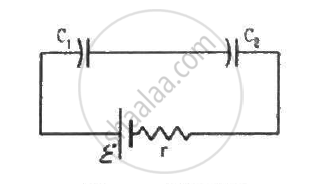
Consider the situation shown in figure. The switch is closed at t = 0 when the capacitors are uncharged. Find the charge on the capacitor C1 as a function of time t.
Advertisements
उत्तर
The two capacitors are connected in series. Their equivalent capacitance,
\[C_{eqv} = \frac{C_1 C_2}{C_1 + C_2}\]
The growth of charge in the capacitors,
\[q = C_{eqv} \epsilon\left( 1 - e^{- \frac{1}{r C_{eqv}}} \right)\]
APPEARS IN
संबंधित प्रश्न
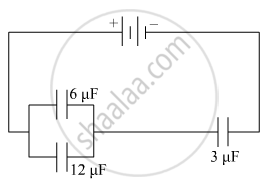
In the following arrangement of capacitors, the energy stored in the 6 µF capacitor is E. Find the value of the following :
(i) Energy stored in 12 µF capacitor.
(ii) Energy stored in 3 µF capacitor.
(iii) Total energy drawn from the battery.
A capacitor of capacitance 500 μF is connected to a battery through a 10 kΩ resistor. The charge stored in the capacitor in the first 5 s is larger than the charge stored in the next.
(a) 5 s
(b) 50 s
(c) 500 s
(d) 500 s
A 20 μF capacitor is joined to a battery of emf 6.0 V through a resistance of 100 Ω. Find the charge on the capacitor 2.0 ms after the connections are made.
The plates of a capacitor of capacitance 10 μF, charged to 60 μC, are joined together by a wire of resistance 10 Ω at t = 0. Find the charge on the capacitor in the circuit at (a) t = 0 (b) t = 30 μs (c) t = 120 μs and (d) t = 1.0 ms.
A 100 μF capacitor is joined to a 24 V battery through a 1.0 MΩ resistor. Plot qualitative graphs (a) between current and time for the first 10 minutes and (b) between charge and time for the same period.
How many time constants will elapse before the energy stored in the capacitor reaches half of its equilibrium value in a charging RC circuit?
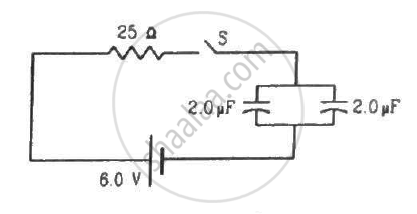
Find the charge on each of the capacitors 0.20 ms after the switch S is closed in the figure.
A capacitor of capacitance C is given a charge Q. At t = 0, it is connected to an ideal battery of emf ε through a resistance R. Find the charge on the capacitor at time t.
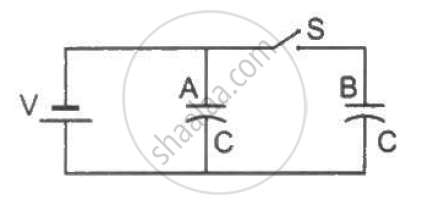
Figure shows two identical parallel plate capacitors connected to a battery through a switch S. Initially, the switch is closed so that the capacitors are completely charged. The switch is now opened and the free space between the plates of the capacitors is filled with a dielectric of dielectric constant 3. Find the ratio of the initial total energy stored in the capacitors to the final total energy stored.
A parallel plate condenser is immersed in an oil of dielectric constant 2. The field between the plates is ______.
What fraction of the energy drawn from the charging battery is stored in a capacitor?
A parallel plate capacitor has a uniform electric field `overset(->)("E")` in the space between the plates. If the distance between the plates is ‘d’ and the area of each plate is ‘A’, the energy stored in the capacitor is ______
(ε0 = permittivity of free space)
Prove that, if an insulated, uncharged conductor is placed near a charged conductor and no other conductors are present, the uncharged body must be intermediate in potential between that of the charged body and that of infinity.
Derive an expression for energy stored in a capacitor.
A parallel combination of two capacitors of capacities ‘C’ and ‘`C/3`’ respectively is connected across a battery of 12 volt. When both capacitors are fully charged, the charge and energy stored in them is Q1, Q2 and E1, E2 respectively. Then the ratio of (E1 − E2) to (Q1 − Q2) is ______.
What is the SI unit of energy stored in a capacitor?
If an additional small charge \(dq\) is supplied to a capacitor when its potential difference is \(V\), what is the small work done?
Evaluating the work integral for charging a capacitor from \(0\) to \(Q\) gives which result?
