Advertisements
Advertisements
प्रश्न
A capacitor of capacitance C is given a charge Q. At t = 0, it is connected to an ideal battery of emf ε through a resistance R. Find the charge on the capacitor at time t.
Advertisements
उत्तर
Given:-
Initial charge given to the capacitor = Q
When the capacitor is connected to a battery, it will charge through the battery. The initial charge will also decay.
The growth of charge across the capacitor due to the battery of emf E,
\[q = CE\left( 1 - e^{- \frac{t}{RC}} \right)\]
The decay of charge through the capacitor,
\[q' = Q e^{- \frac{t}{RC}}\]
The net charge on the capacitor at any time t,
\[q_{net} = q + q'\]
\[ = CE\left( 1 - e^{- \frac{t}{RC}} \right) + Q e^{- \frac{t}{RC}}\]
APPEARS IN
संबंधित प्रश्न
A 12 pF capacitor is connected to a 50 V battery. How much electrostatic energy is stored in the capacitor?
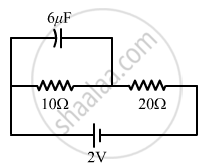
Find the charge on the capacitor as shown in the circuit.
A capacitor of capacitance 500 μF is connected to a battery through a 10 kΩ resistor. The charge stored in the capacitor in the first 5 s is larger than the charge stored in the next.
(a) 5 s
(b) 50 s
(c) 500 s
(d) 500 s
A 20 μF capacitor is joined to a battery of emf 6.0 V through a resistance of 100 Ω. Find the charge on the capacitor 2.0 ms after the connections are made.
The plates of a capacitor of capacitance 10 μF, charged to 60 μC, are joined together by a wire of resistance 10 Ω at t = 0. Find the charge on the capacitor in the circuit at (a) t = 0 (b) t = 30 μs (c) t = 120 μs and (d) t = 1.0 ms.
How many time constants will elapse before the charge on a capacitors falls to 0.1% of its maximum value in a discharging RC circuit?
Two capacitors of capacitances 4⋅0 µF and 6⋅0 µF are connected in series with a battery of 20 V. Find the energy supplied by the battery.
A capacitance C charged to a potential difference V is discharged by connecting its plates through a resistance R. Find the heat dissipated in one time constant after the connections are made. Do this by calculating ∫ i2R dt and also by finding the decrease in the energy stored in the capacitor.
A capacitor of capacitance 100 μF is connected across a battery of emf 6 V through a resistance of 20 kΩ for 4 s. The battery is then replaced by a thick wire. What will be the charge on the capacitor 4 s after the battery is disconnected?
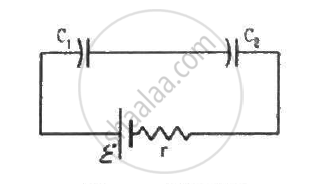
Consider the situation shown in figure. The switch is closed at t = 0 when the capacitors are uncharged. Find the charge on the capacitor C1 as a function of time t.
A capacitor of capacitance C is given a charge Q. At t = 0, it is connected to an uncharged capacitor of equal capacitance through a resistance R. Find the charge on the second capacitor as a function of time.
A metal sphere of radius R is charged to a potential V.
- Find the electrostatic energy stored in the electric field within a concentric sphere of radius 2 R.
- Show that the electrostatic field energy stored outside the sphere of radius 2 R equals that stored within it.
A large conducting plane has a surface charge density `1.0 xx 10^-4 "Cm"^-2` . Find the electrostatic energy stored in a cubical volume of edge 1⋅0 cm in front of the plane.
What fraction of the energy drawn from the charging battery is stored in a capacitor?
Derive an expression for energy stored in a capacitor.
In a capacitor of capacitance 20 µF, the distance between the plates is 2 mm. If a dielectric slab of width 1 mm and dielectric constant 2 is inserted between the plates, what is the new capacitance?
If the charge on the parallel plate capacitor is increased by 3 C, the energy stored in it increases by 44%. The original charge on the capacitor is ______.
A parallel combination of two capacitors of capacities ‘C’ and ‘`C/3`’ respectively is connected across a battery of 12 volt. When both capacitors are fully charged, the charge and energy stored in them is Q1, Q2 and E1, E2 respectively. Then the ratio of (E1 − E2) to (Q1 − Q2) is ______.
