Advertisements
Advertisements
प्रश्न
The plates of a capacitor of capacitance 10 μF, charged to 60 μC, are joined together by a wire of resistance 10 Ω at t = 0. Find the charge on the capacitor in the circuit at (a) t = 0 (b) t = 30 μs (c) t = 120 μs and (d) t = 1.0 ms.
Advertisements
उत्तर
Given:-
Capacitance of the capacitor, C = 10 μF
Initial charge on capacitor, Q = 60 μC
Resistance of the circuit, R = 10 Ω
(a)Decay of charge on the capacitor,
\[q = Q e^{- \frac{t}{RC}}\]
At t = 0,
q = Q = 60 μC
(b) At t = 30 μs,
\[q = Q . e^{- \frac{t}{RC}} \]
\[ \Rightarrow q = Q . e^{- \frac{30 \times {10}^{- 6}}{10 \times 10 \times {10}^{- 6}}} \]
\[ \Rightarrow q = 60 . e^{- 0 . 3} \]
\[ \Rightarrow q = 44 \mu C\]
(c) At t = 120 μs,
\[q = Q . e^{- \frac{t}{RC}} \]
\[ \Rightarrow q = Q . e^{- \frac{120 \times {10}^{- 6}}{10 \times 10 \times {10}^{- 6}}} \]
\[ \Rightarrow q = 60 . e^{- 1 . 2} \]
\[ \Rightarrow q = 18 \mu C\]
(d) At t = 1 ms,
\[q = Q . e^{- \frac{t}{RC}} \]
\[ \Rightarrow q = Q . e^{- \frac{1 \times {10}^{- 3}}{10 \times 10 \times {10}^{- 6}}} \]
\[ \Rightarrow q = 60 . e^{- 10} \]
\[ \Rightarrow q = 0 . 003 \mu C\]
APPEARS IN
संबंधित प्रश्न
The energy density in the electric field created by a point charge falls off with the distance from the point charge as
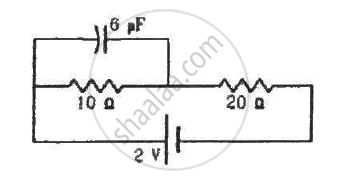
Find the charge on the capacitor shown in the figure.
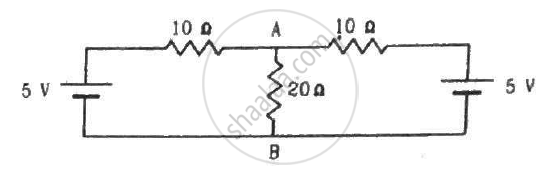
(a) Find the current in the 20 Ω resistor shown in the figure. (b) If a capacitor of capacitance 4 μF is joined between the points A and B, what would be the electrostatic energy stored in it in steady state?
A capacitance C, a resistance R and an emf ε are connected in series at t = 0. What is the maximum value of (a) the potential difference across the resistor (b) the current in the circuit (c) the potential difference across the capacitor (d) the energy stored in the capacitor (e) the power delivered by the battery and (f) the power converted into heat?
A 20 μF capacitor is joined to a battery of emf 6.0 V through a resistance of 100 Ω. Find the charge on the capacitor 2.0 ms after the connections are made.
A capacitor of capacitance 12.0 μF is connected to a battery of emf 6.00 V and internal resistance 1.00 Ω through resistanceless leads. 12.0 μs after the connections are made, what will be (a) the current in the circuit (b) the power delivered by the battery (c) the power dissipated in heat and (d) the rate at which the energy stored in the capacitor is increasing?
By evaluating ∫i2Rdt, show that when a capacitor is charged by connecting it to a battery through a resistor, the energy dissipated as heat equals the energy stored in the capacitor.
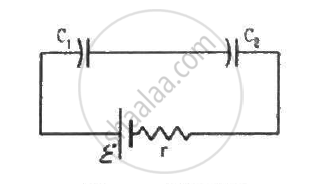
Consider the situation shown in figure. The switch is closed at t = 0 when the capacitors are uncharged. Find the charge on the capacitor C1 as a function of time t.
A capacitor of capacitance C is given a charge Q. At t = 0, it is connected to an uncharged capacitor of equal capacitance through a resistance R. Find the charge on the second capacitor as a function of time.
A metal sphere of radius R is charged to a potential V.
- Find the electrostatic energy stored in the electric field within a concentric sphere of radius 2 R.
- Show that the electrostatic field energy stored outside the sphere of radius 2 R equals that stored within it.
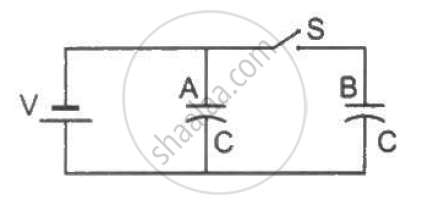
Figure shows two identical parallel plate capacitors connected to a battery through a switch S. Initially, the switch is closed so that the capacitors are completely charged. The switch is now opened and the free space between the plates of the capacitors is filled with a dielectric of dielectric constant 3. Find the ratio of the initial total energy stored in the capacitors to the final total energy stored.
Choose the correct option:
Energy stored in a capacitor and dissipated during charging a capacitor bear a ratio.
A capacitor is a device that stores ____________.
A capacitor is charged by a battery and energy stored is 'U'. Now the battery is removed and the distance between plates is increased to four times. The energy stored becomes ______.
A fully charged capacitor C with initial charge q0 is connected to a coil of self-inductance L at t = 0. The time at which the energy is stored equally between the electric and magnetic fields is ______.
In a capacitor of capacitance 20 µF, the distance between the plates is 2 mm. If a dielectric slab of width 1 mm and dielectric constant 2 is inserted between the plates, what is the new capacitance?
If the charge on the parallel plate capacitor is increased by 3 C, the energy stored in it increases by 44%. The original charge on the capacitor is ______.
Where is the electrical potential energy stored when a capacitor is charged?
What is called the energy stored in a capacitor?
