Advertisements
Advertisements
Question
A capacitor C1 of capacitance 1 μF and a capacitor C2 of capacitance 2 μF are separately charged by a common battery for a long time. The two capacitors are then separately discharged through equal resistors. Both the discharge circuits are connected at t = 0.
(a) The current in each of the two discharging circuits is zero at t = 0.
(b) The currents in the two discharging circuits at t = 0 are equal but not zero.
(c) The currents in the two discharging circuits at t = 0 are unequal.
(d) C1 loses 50% of its initial charge sooner than C2 loses 50% of its initial charge.
Advertisements
Solution
(b) The currents in the two discharging circuits at t = 0 are equal but not zero.
(d) C1 loses 50% of its initial charge sooner than C2 loses 50% of its initial charge.
Let the voltage of the battery connected to the capacitors be V. Both the capacitors will charge up to the same potential (V).
The charge on the capacitors C1 is C1V = (1 μF)×V
The charge on the capacitors C2 is C2V = (2 μF)×V
The charge on the discharging circuit at an instant t,
\[Q = CV e^{- t/RC}\]
The current through the discharging circuit,
\[\frac{dQ}{dt} = - \frac{CV}{RC} e^{- t/RC} = \frac{V}{R} e^{- t/RC}\]
At t = 0, the current through the discharging circuit will be `V/R` for both the capacitors.
Let the time taken by the capacitor C1 to lose 50% of the charge be t1.
\[Q_1 = \frac{C_1 V}{2}\]
\[\frac{C_1 V}{2} = C_1 V e^{- t_1 /RC} \]
\[\frac{1}{2} = e^{- t_1 /RC}\]
Taking natural log on both sides, we get:-
\[- \ln2 = - \frac{t_1}{R C_1}\]
\[ t_1 = R C_1 \ln2\]
Similarly,
Time taken for capacitor C2:-
\[t_2 = R C_2 \ln2\]
As, C1 < C2, t1 < t2
Thus, we can say that C1 loses 50% of its initial charge sooner than C2 loses 50% of its initial charge.
APPEARS IN
RELATED QUESTIONS
A 12 pF capacitor is connected to a 50 V battery. How much electrostatic energy is stored in the capacitor?
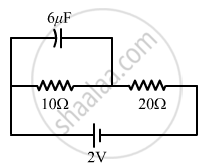
Find the charge on the capacitor as shown in the circuit.
Find the ratio of energy stored in the two configurations if they are both connected to the same source.
A capacitor of capacitance 500 μF is connected to a battery through a 10 kΩ resistor. The charge stored in the capacitor in the first 5 s is larger than the charge stored in the next.
(a) 5 s
(b) 50 s
(c) 500 s
(d) 500 s
How many time constants will elapse before the current in a charging RC circuit drops to half of its initial value? Answer the same question for a discharging RC circuit.
A capacitor of capacitance 12.0 μF is connected to a battery of emf 6.00 V and internal resistance 1.00 Ω through resistanceless leads. 12.0 μs after the connections are made, what will be (a) the current in the circuit (b) the power delivered by the battery (c) the power dissipated in heat and (d) the rate at which the energy stored in the capacitor is increasing?
A capacitor with stored energy 4⋅0 J is connected with an identical capacitor with no electric field in between. Find the total energy stored in the two capacitors.
A capacitor of capacitance C is given a charge Q. At t = 0, it is connected to an ideal battery of emf ε through a resistance R. Find the charge on the capacitor at time t.
A metal sphere of radius R is charged to a potential V.
- Find the electrostatic energy stored in the electric field within a concentric sphere of radius 2 R.
- Show that the electrostatic field energy stored outside the sphere of radius 2 R equals that stored within it.
A large conducting plane has a surface charge density `1.0 xx 10^-4 "Cm"^-2` . Find the electrostatic energy stored in a cubical volume of edge 1⋅0 cm in front of the plane.
Obtain the expression for the energy stored in a capacitor connected across a dc battery.
A parallel plate condenser is immersed in an oil of dielectric constant 2. The field between the plates is ______.
An air-filled parallel plate capacitor has a uniform electric field `overset(->)("E")` in the space between the plates. If the distance between the plates is 'd' and the area of each plate is 'A', the energy stored in the capacitor is ______
(∈0 = permittivity of free space)
What fraction of the energy drawn from the charging battery is stored in a capacitor?
A parallel plate capacitor (A) of capacitance C is charged by a battery to voltage V. The battery is disconnected and an uncharged capacitor (B) of capacitance 2C is connected across A. Find the ratio of total electrostatic energy stored in A and B finally and that stored in A initially.
Derive an expression for energy stored in a capacitor.
In a capacitor of capacitance 20 µF, the distance between the plates is 2 mm. If a dielectric slab of width 1 mm and dielectric constant 2 is inserted between the plates, what is the new capacitance?
Which set gives the equivalent expressions for the energy stored in a capacitor?
