Advertisements
Advertisements
प्रश्न
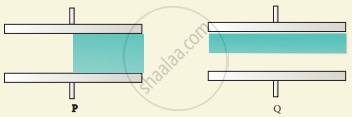
Capacitors P and Q have identical cross-sectional areas A and separation d. The space between the capacitors is filled with a dielectric of dielectric constant Er as shown in the figure. Calculate the capacitance of capacitors P and Q.
Advertisements
उत्तर
- The arrangement can be supposed to be a parallel combination of two capacitors each with plate area A/2 and separation. d. Total capacitance `"C"_"p" = "C"_"air" + "C"_"dielectric"`
`= (epsilon_0("A"//2))/"d" + (epsilon_0("A"//2)epsilon"r")/"d"`
`"C"_"p" = (epsilon_0"A")/"2d" (1 + epsilon_"r")` - The arrangement can be supposed to be a series combination of two capacitors, each with plate area A and separation d/2.
Total capacitance CQ = `("C"_1"C"_2)/("C"_1 + "C"_2)`
`= ((2epsilon_0"A")/"d" xx (2epsilon_"r"epsilon_0"A")/"d")/((2epsilon_0"A")/"d" + (2epsilon_"r"epsilon_0"A")/"d")`
`= (4epsilon_"r" ((epsilon_0"A")/"d")^2)/((2epsilon_0"A")/"d" (1 + epsilon_"r"))`
`= (2epsilon_"r" (epsilon_0"A")/"d")/(1 + epsilon_"r")`
`"C"_"Q" = (2epsilon_0"A")/"d" (epsilon_"r"/(1 + epsilon_"r"))`
APPEARS IN
संबंधित प्रश्न
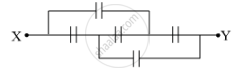
Find the equivalent capacitance of the network shown in the figure, when each capacitor is of 1 μF. When the ends X and Y are connected to a 6 V battery, find out (i) the charge and (ii) the energy stored in the network.
A capacitor of unknown capacitance is connected across a battery of V volts. The charge stored in it is 300 μC. When potential across the capacitor is reduced by 100 V, the charge stored in it becomes 100 μC. Calculate The potential V and the unknown capacitance. What will be the charge stored in the capacitor if the voltage applied had increased by 100 V?
Two capacitors each having capacitance C and breakdown voltage V are joined in series. The capacitance and the breakdown voltage of the combination will be
It is required to construct a 10 µF capacitor which can be connected across a 200 V battery. Capacitors of capacitance 10 µF are available but they can withstand only 50 V. Design a combination which can yield the desired result.
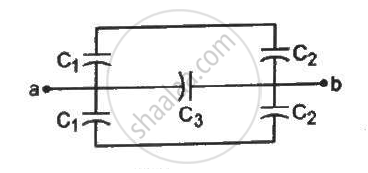
Find the equivalent capacitance of the system shown in figure between the points a and b.
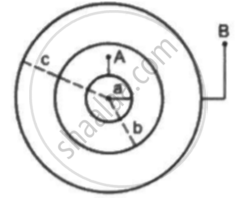
Consider an assembly of three conducting concentric spherical shell of radii a, b and c as shown in figure Find the capacitance of the assembly between the points Aand B.
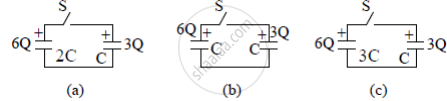
Three circuits, each consisting of a switch 'S' and two capacitors, are initially charged, as shown in the figure. After the switch has been closed, in which circuit will the charge on the left-hand capacitor
(i) increase,
(ii) decrease, and
(iii) remains the same? Give reasons.
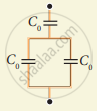
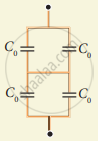
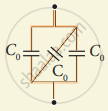
Calculate the resultant capacitances for each of the following combinations of capacitors.
The radius of a sphere of capacity 1 microfarad in the air is ______
