Advertisements
Advertisements
प्रश्न
A parallel plate capacitor (A) of capacitance C is charged by a battery to voltage V. The battery is disconnected and an uncharged capacitor (B) of capacitance 2C is connected across A. Find the ratio of final charges on A and B.
Advertisements
उत्तर
The electric field in the region between the plates depends on the change given to the conducting plates,

For capacitor 'A' of capacitance C, having voltage V, the charge on it is given by Q = CV.
On connecting this capacitor A with capacitor B changes get distributed.

Now, `q_1 + q_2 = Q`
`q_1 + q_2` = CV
`CV_1 + 2CV_1 = CV`
`V_1 = V/3`
∴ `q_1 = (CV)/3`
`q_2 = (2CV)/3`
∴ The ratio of final changes on A and B:
`q_1/q_2 = (CV"/"3)/(2CV"/"3) = 1/2`
APPEARS IN
संबंधित प्रश्न
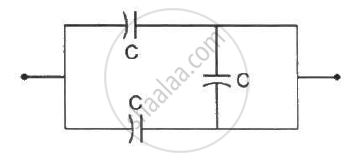
The equivalent capacitance of the combination shown in the figure is _________ .
The plates of a parallel-plate capacitor are made of circular discs of radii 5⋅0 cm each. If the separation between the plates is 1⋅0 mm, what is the capacitance?
Suppose, one wishes to construct a 1⋅0 farad capacitor using circular discs. If the separation between the discs be kept at 1⋅0 mm, what would be the radius of the discs?
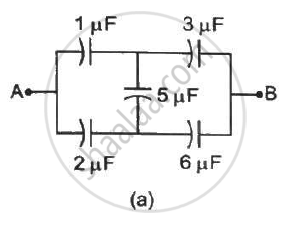
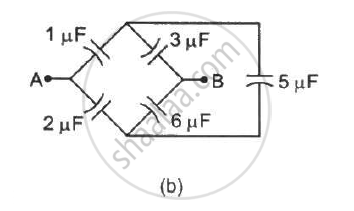
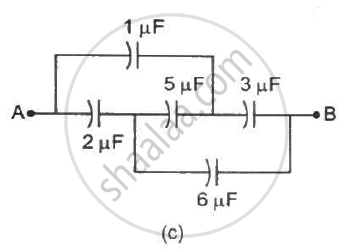
Convince yourself that parts (a), (b) and (c) figure are identical. Find the capacitance between the points A and B of the assembly.
The two square faces of a rectangular dielectric slab (dielectric constant 4⋅0) of dimensions 20 cm × 20 cm × 1⋅0 mm are metal-coated. Find the capacitance between the coated surfaces.
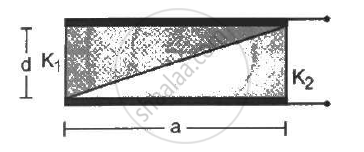
A capacitor is formed by two square metal-plates of edge a, separated by a distance d. Dielectrics of dielectric constant K1 and K2 are filled in the gap as shown in figure . Find the capacitance.
Two similar conducting spheres having charge+ q and -q are placed at 'd' seperation from each other in air. The radius of each ball is r and the separation between their centre is d (d >> r). Calculate the capacitance of the two ball system ______.

What does a large capacitance mean in terms of charge storage and potential difference?
In a series combination, which statement describes the potential difference across each capacitor?
In a parallel combination, which quantity is the same across each capacitor?
