Advertisements
Advertisements
प्रश्न
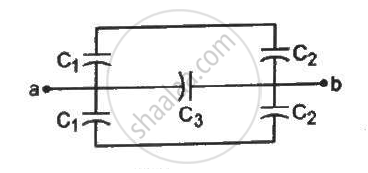
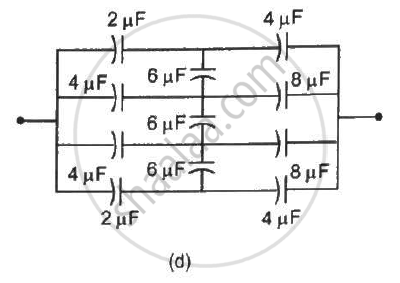
Find the equivalent capacitance of the system shown in figure between the points a and b.
Advertisements
उत्तर
Capacitors C1 and C2 above and below ab are connected in series and in parallel with C3.
Thus, the equivalent capacitor between a and b is given by
`C_(eq) = (C_1C_2)/(C_1+C_2) + C_3 + (C_1C_2)/(C_1+C_2)`
`⇒ C_(eq) = C_3 + (2C_1C_2)/(C_1+C_2)`
APPEARS IN
संबंधित प्रश्न
A parallel plate capacitor of capacitance C is charged to a potential V. It is then connected to another uncharged capacitor having the same capacitance. Find out the ratio of the energy stored in the combined system to that stored initially in the single capacitor.
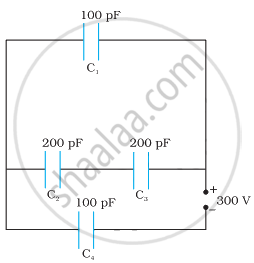
Obtain the equivalent capacitance of the network in Figure. For a 300 V supply, determine the charge and voltage across each capacitor.
(i) Find equivalent capacitance between A and B in the combination given below. Each capacitor is of 2 µF capacitance.
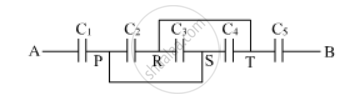
(ii) If a dc source of 7 V is connected across AB, how much charge is drawn from the source and what is the energy stored in the network?
Two capacitors each having capacitance C and breakdown voltage V are joined in series. The capacitance and the breakdown voltage of the combination will be
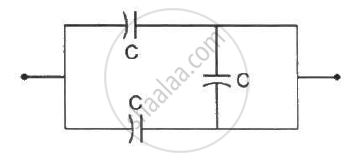
The equivalent capacitance of the combination shown in the figure is _________ .
Two conducting spheres of radii R1 and R2 are kept widely separated from each other. What are their individual capacitances? If the spheres are connected by a metal wire, what will be the capacitance of the combination? Think in terms of series−parallel connections.
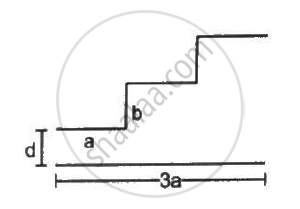
A capacitor is made of a flat plate of area A and a second plate having a stair-like structure as shown in figure . The width of each stair is a and the height is b. Find the capacitance of the assembly.
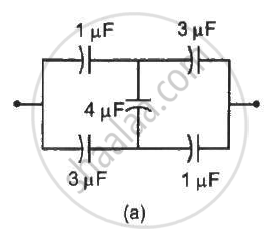
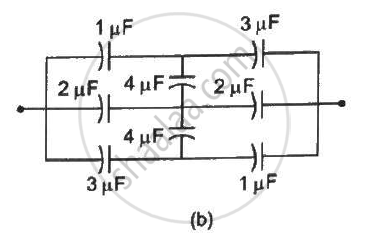
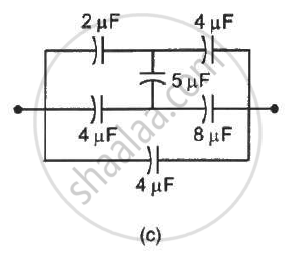
Find the equivalent capacitances of the combinations shown in figure between the indicated points.
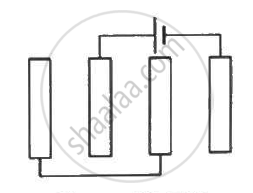
Each of the plates shown in figure has surface area `(96/∈_0) xx 10^-12` Fm on one side and the separation between the consecutive plates is 4⋅0 mm. The emf of the battery connected is 10 volts. Find the magnitude of the charge supplied by the battery to each of the plates connected to it.
A 5⋅0 µF capacitor is charged to 12 V. The positive plate of this capacitor is now connected to the negative terminal of a 12 V battery and vice versa. Calculate the heat developed in the connecting wires.
A parallel-plate capacitor of plate area A and plate separation d is charged to a potential difference V and then the battery is disconnected. A slab of dielectric constant K is then inserted between the plates of the capacitor so as to fill the space between the plates. Find the work done on the system in the process of inserting the slab.
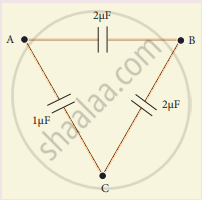
Three capacitors are connected in a triangle as shown in the figure. The equivalent capacitance between points A and C is ______.
The positive terminal of 12 V battery is connected to the ground. Then the negative terminal will be at ______.
For changing the capacitance of a given parallel plate capacitor, a dielectric material of dielectric constant K is used, which has the same area as the plates of the capacitor.
The thickness of the dielectric slab is `3/4`d, where 'd' is the separation between the plate of the parallel plate capacitor.
The new capacitance (C') in terms of the original capacitance (C0) is given by the following relation:
Which units are capacitors commonly measured in practice?
In a series combination, which statement describes the potential difference across each capacitor?
Which combination has charge as its constant quantity and potential difference as its variable quantity?
