Advertisements
Advertisements
प्रश्न
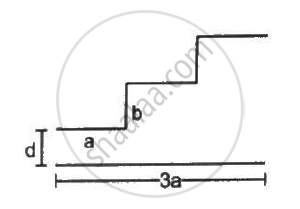
A capacitor is made of a flat plate of area A and a second plate having a stair-like structure as shown in figure . The width of each stair is a and the height is b. Find the capacitance of the assembly.
Advertisements
उत्तर
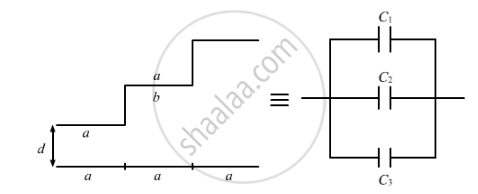
The total area of the flat plate is A. The width of each stair is the same. Therefore, the area of the surface of each stair facing the flat plate is the same, that is, `A/3` .
From the figure, it can be observed that the capacitor assembly is made up of three capacitors. The three capacitors are connected in parallel.
For capacitor C1, the area of the plates is `A/3` and the separation between the plates is d.
For capacitor C2, the area of the plates is `A/3` and the separation between the plates is (d + b).
For capacitor C3, the area of the plates is `A/3` and the separation between the plates is (d + 2b).
Therefore ,
`C_1 = (∈_0A)/(3d)`
`C_2 = (∈_0A)/(3(d+b)`
`C_3 = (∈_0A)/(3(d+2b)`
As the three capacitors are in parallel combination,
`C = C_1 + C_2 + C_3`
⇒ `C = (∈_0A)/(3d) + (∈_0A)/(3(d+b)) + (∈_0A)/(3(d+2b)`
⇒ `C = (∈_0A)/3 ((3d^2 + 6bd + 2b^2))/(d(d+b)(d+2b))`
APPEARS IN
संबंधित प्रश्न
A spherical capacitor consists of two concentric spherical conductors, held in position by suitable insulating supports. Show that the capacitance of a spherical capacitor is given by
C = `(4piin_0"r"_1"r"_2)/("r"_1 - "r"_2)`
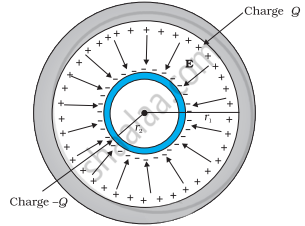
where r1 and r2 are the radii of outer and inner spheres, respectively.
A spherical capacitor has an inner sphere of radius 12 cm and an outer sphere of radius 13 cm. The outer sphere is earthed and the inner sphere is given a charge of 2.5 µC. The space between the concentric spheres is filled with a liquid of dielectric constant 32.
(a) Determine the capacitance of the capacitor.
(b) What is the potential of the inner sphere?
(c) Compare the capacitance of this capacitor with that of an isolated sphere of radius 12 cm. Explain why the latter is much smaller.
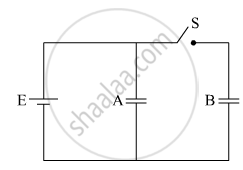
Two identical parallel plate capacitors A and B are connected to a battery of V volts with the switch S closed. The switch is now opened and the free space between the plates of the capacitors is filled with a dielectric of dielectric constant K. Find the ratio of the total electrostatic energy stored in both capacitors before and after the introduction of the dielectric.
A capacitor of unknown capacitance is connected across a battery of V volts. The charge stored in it is 360 μC. When potential across the capacitor is reduced by 120 V, the charge stored in it becomes 120 μC.
Calculate:
(i) The potential V and the unknown capacitance C.
(ii) What will be the charge stored in the capacitor, if the voltage applied had increased by 120 V?
A capacitor of capacitance C is charged to a potential V. The flux of the electric field through a closed surface enclosing the capacitor is
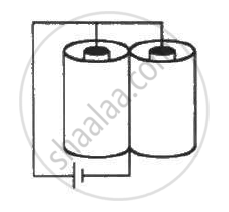
The outer cylinders of two cylindrical capacitors of capacitance 2⋅2 µF each, are kept in contact and the inner cylinders are connected through a wire. A battery of emf 10 V is connected as shown in figure . Find the total charge supplied by the battery to the inner cylinders.
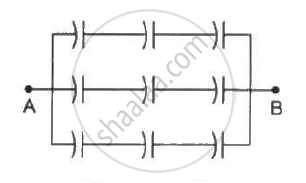
Each of the capacitors shown in figure has a capacitance of 2 µF. find the equivalent capacitance of the assembly between the points A and B. Suppose, a battery of emf 60 volts is connected between A and B. Find the potential difference appearing on the individual capacitors.
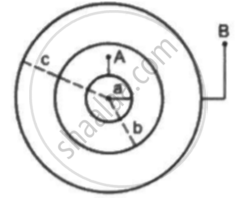
Consider an assembly of three conducting concentric spherical shell of radii a, b and c as shown in figure Find the capacitance of the assembly between the points Aand B.
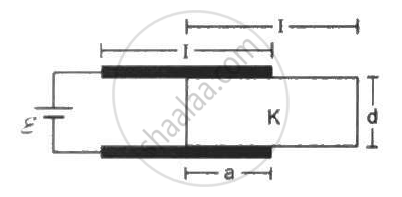
Consider the situation shown in figure. The plates of the capacitor have plate area A and are clamped in the laboratory. The dielectric slab is released from rest with a length a inside the capacitor. Neglecting any effect of friction or gravity, show that the slab will execute periodic motion and find its time period.
If the voltage applied on a capacitor is increased from V to 2V, choose the correct conclusion.
Define ‘capacitance’. Give its unit.
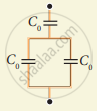
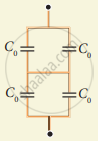
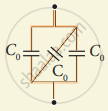
Calculate the resultant capacitances for each of the following combinations of capacitors.
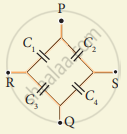
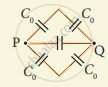
When air is replaced by a dielectric medium of constant K, the maximum force of attraction between two charges separated by a distance ______.
A parallel plate capacitor is filled by a dielectric whose relative permittivity varies with the applied voltage (U) as ε = αU where α = 2V–1. A similar capacitor with no dielectric is charged to U0 = 78V. It is then connected to the uncharged capacitor with the dielectric. Find the final voltage on the capacitors.
Which system is called a capacitor?
Which statement lists the factors on which capacitance depends?
For a given capacitor, what fixes its capacitance?
In a series combination, which statement describes the potential difference across each capacitor?
What is the practical purpose of a parallel combination of capacitors?
