Advertisements
Advertisements
प्रश्न
Obtain the expression for energy stored in the parallel plate capacitor.
Advertisements
उत्तर
- Capacitor not only stores the charge but also stores energy.
- When a battery is connected to the capacitor, electrons of total charge -Q are transferred from one plate to the other plate.
- To transfer the charge, work is done by the battery. This work done is stored as electrostatic potential energy in the capacitor.
- To transfer an infinitesimal charge dQ for a potential difference V, the work done is given by
dW = V dQ ………….(1)
where V = `"Q"/"C"`
The total work done to charge a capacitor is
W = `int_0^"Q" "Q"/"C" "dQ" = "Q"^2/"2C"` .....(2)
This work done is stored as electrostatic potential energy (UB) in the capacitor.
`"U"_"E" = "Q"^2/"2C" = 1/2 "CV"^2` ....(3)
where Q = CV is used. - This stored energy is thus directly proportional to the capacitance of the capacitor and the square of the voltage between the plates of the capacitor.
`"U"_"E" = 1/2 ((ε_0"A")/"d")("Ed")^2 = 1/2 ε_0 ("Ad")"E"^2` ....(4)
where Ad = volume of the space between the capacitor plates. The energy stored per unit volume of space is defined `"U"_"E" = 1/2ε_0 "E"^2` .....(5) - Energy is stored in the electric field existing between the plates of the capacitor. 0nce the capacitor is allowed to discharge, the energy is retrieved.
- The energy density depends only on the electric field and not on the size of the plates of the capacitor.
APPEARS IN
संबंधित प्रश्न
Three identical capacitors C1, C2 and C3 of capacitance 6 μF each are connected to a 12 V battery as shown.
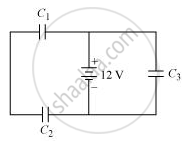
Find
(i) charge on each capacitor
(ii) equivalent capacitance of the network
(iii) energy stored in the network of capacitors
A capacitor has capacitance C. Is this information sufficient to know what maximum charge the capacitor can contain? If yes, what is this charges? If no, what other information is needed?
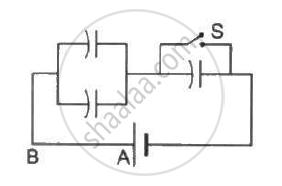
Each capacitor shown in figure has a capacitance of 5⋅0 µF. The emf of the battery is 50 V. How much charge will flow through AB if the switch S is closed?
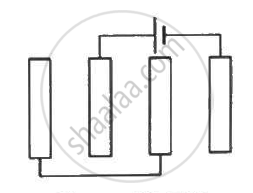
Each of the plates shown in figure has surface area `(96/∈_0) xx 10^-12` Fm on one side and the separation between the consecutive plates is 4⋅0 mm. The emf of the battery connected is 10 volts. Find the magnitude of the charge supplied by the battery to each of the plates connected to it.
A parallel-plate capacitor of plate area A and plate separation d is charged to a potential difference V and then the battery is disconnected. A slab of dielectric constant K is then inserted between the plates of the capacitor so as to fill the space between the plates. Find the work done on the system in the process of inserting the slab.
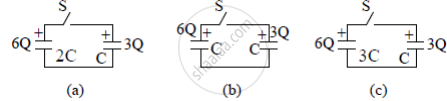
Three circuits, each consisting of a switch 'S' and two capacitors, are initially charged, as shown in the figure. After the switch has been closed, in which circuit will the charge on the left-hand capacitor
(i) increase,
(ii) decrease, and
(iii) remains the same? Give reasons.
For changing the capacitance of a given parallel plate capacitor, a dielectric material of dielectric constant K is used, which has the same area as the plates of the capacitor.
The thickness of the dielectric slab is `3/4`d, where 'd' is the separation between the plate of the parallel plate capacitor.
The new capacitance (C') in terms of the original capacitance (C0) is given by the following relation:
Which system is called a capacitor?
Which statement lists the factors on which capacitance depends?
What is the practical purpose of a series combination of capacitors?
