Advertisements
Advertisements
प्रश्न
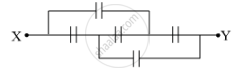
Find the equivalent capacitance of the network shown in the figure, when each capacitor is of 1 μF. When the ends X and Y are connected to a 6 V battery, find out (i) the charge and (ii) the energy stored in the network.
Advertisements
उत्तर
The equivalent circuit is given below.
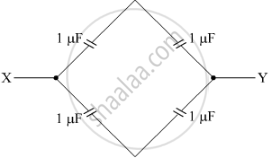
There are two capacitors in one branch in series. So, the equivalent capacitance of one branch will be
1/1+1/1=2muF
The arrangement will be further reduced to the form given below.
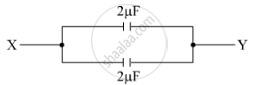
Now, both the capacitors are in parallel, so the equivalent capacitance will be
2+2=4μF
Therefore, the equivalent capacitance is 4 μF.
(i)
Voltage, V = 6 V
The charge in the network is given by
q=CV
Here, C is the equivalent capacitance.
Now,q=4×10−6×6
=24×10−6 C=24 μC
(ii)
The energy stored in the network is given by
E=1/2CV2
=12×4×10−6×(6)2
=12×4×36×10−6
=72×10−6 J
=72 μJ
APPEARS IN
संबंधित प्रश्न
A capacitor of capacitance C is charged fully by connecting it to a battery of emf E. It is then disconnected from the battery. If the separation between the plates of the capacitor is now doubled, how will the following change?
(i) charge stored by the capacitor.
(ii) Field strength between the plates.
(iii) Energy stored by the capacitor.
Justify your answer in each case.
A capacitor of capacitance ‘C’ is charged to ‘V’ volts by a battery. After some time the battery is disconnected and the distance between the plates is doubled. Now a slab of dielectric constant, 1 < k < 2, is introduced to fill the space between the plates. How will the following be affected? (a) The electric field between the plates of the capacitor Justify your answer by writing the necessary expressions.
Three identical capacitors C1, C2 and C3 of capacitance 6 μF each are connected to a 12 V battery as shown.
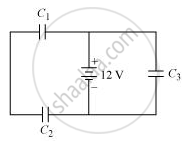
Find
(i) charge on each capacitor
(ii) equivalent capacitance of the network
(iii) energy stored in the network of capacitors
Find the equivalent capacitances of the combinations shown in figure between the indicated points.
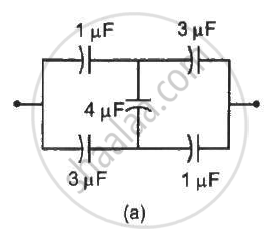
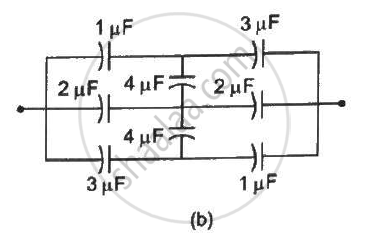
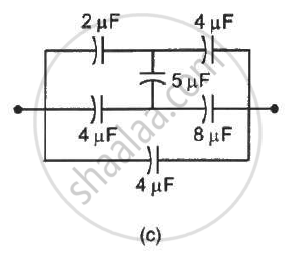
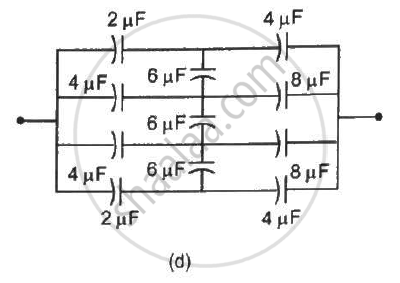
Obtain the expression for energy stored in the parallel plate capacitor.
During a thunder storm, the movement of water molecules within the clouds creates friction, partially causing the bottom part of the clouds to become negatively charged. This implies that the bottom of the cloud and the ground act as a parallel plate capacitor. If the electric field between the cloud and ground exceeds the dielectric breakdown of the air (3 × 10⁶ Vm–1), lightning will occur.
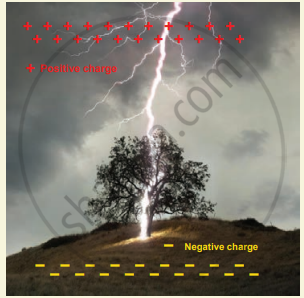
- If the bottom part of the cloud is 1000 m above the ground, determine the electric potential difference that exists between the cloud and ground.
- In a typical lightning phenomenon, around 25 C of electrons are transferred from cloud to ground. How much electrostatic potential energy is transferred to the ground?
Between the plates of parallel plate condenser there is 1 mm thick medium shoot of dielectric constant 4. It is charged at 100 volt. The electric field in volt/meter between the plates of capacitor is ______.
What is called the capacity of conductor?
What is the SI unit of capacitance?
Which units are capacitors commonly measured in practice?
