Advertisements
Advertisements
प्रश्न
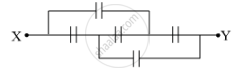
Find the equivalent capacitance of the network shown in the figure, when each capacitor is of 1 μF. When the ends X and Y are connected to a 6 V battery, find out (i) the charge and (ii) the energy stored in the network.
Advertisements
उत्तर
The equivalent circuit is given below.
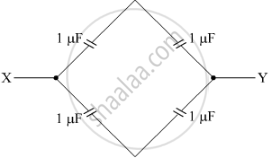
There are two capacitors in one branch in series. So, the equivalent capacitance of one branch will be
1/1+1/1=2muF
The arrangement will be further reduced to the form given below.
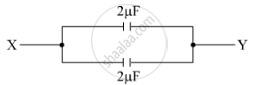
Now, both the capacitors are in parallel, so the equivalent capacitance will be
2+2=4μF
Therefore, the equivalent capacitance is 4 μF.
(i)
Voltage, V = 6 V
The charge in the network is given by
q=CV
Here, C is the equivalent capacitance.
Now,q=4×10−6×6
=24×10−6 C=24 μC
(ii)
The energy stored in the network is given by
E=1/2CV2
=12×4×10−6×(6)2
=12×4×36×10−6
=72×10−6 J
=72 μJ
APPEARS IN
संबंधित प्रश्न
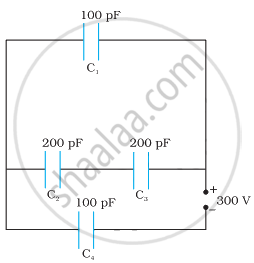
Obtain the equivalent capacitance of the network in Figure. For a 300 V supply, determine the charge and voltage across each capacitor.
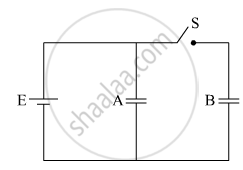
Two identical parallel plate capacitors A and B are connected to a battery of V volts with the switch S closed. The switch is now opened and the free space between the plates of the capacitors is filled with a dielectric of dielectric constant K. Find the ratio of the total electrostatic energy stored in both capacitors before and after the introduction of the dielectric.
A capacitor of unknown capacitance is connected across a battery of V volts. The charge stored in it is 300 μC. When potential across the capacitor is reduced by 100 V, the charge stored in it becomes 100 μC. Calculate The potential V and the unknown capacitance. What will be the charge stored in the capacitor if the voltage applied had increased by 100 V?
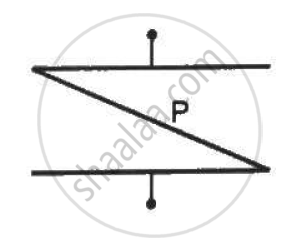
A thin metal plate P is inserted between the plates of a parallel-plate capacitor of capacitance C in such a way that its edges touch the two plates . The capacitance now becomes _________ .
Three capacitors having capacitances 20 µF, 30 µF and 40 µF are connected in series with a 12 V battery. Find the charge on each of the capacitors. How much work has been done by the battery in charging the capacitors?
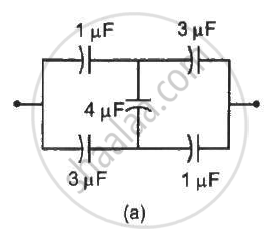
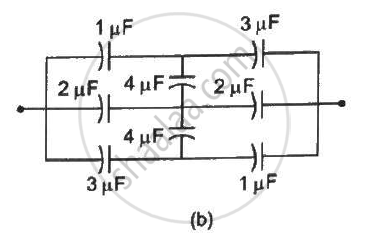
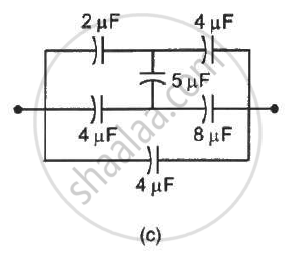
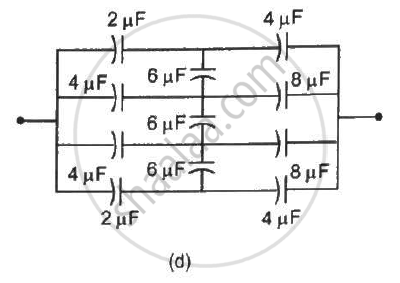
Find the equivalent capacitances of the combinations shown in figure between the indicated points.
Derive the expression for resultant capacitance, when the capacitor is connected in series.
Consider two conducting spheres of radii R1 and R2 with R1 > R2. If the two are at the same potential, the larger sphere has more charge than the smaller sphere. State whether the charge density of the smaller sphere is more or less than that of the larger one.
Which system is called a capacitor?
In a parallel combination, which statement describes the charges on the capacitors?
