Advertisements
Advertisements
प्रश्न
What is the area of the plates of a 2 F parallel plate capacitor, given that the separation between the plates is 0.5 cm? [You will realize from your answer why ordinary capacitors are in the range of µF or less. However, electrolytic capacitors do have a much larger capacitance (0.1 F) because of very minute separation between the conductors.]
Advertisements
उत्तर
Capacitance of a parallel capacitor, V = 2 F
Distance between the two plates, d = 0.5 cm = 0.5 × 10⁻² m
Capacitance of a parallel plate capacitor is given by the relation,
C = `(in_0"A")/"d"`
A = `("Cd")/in_0`
Where,
`in_0` = Permittivity of free space = 8.85 × 10⁻¹² C2 N−1 m−2
∴ A = `(2 xx 0.5 xx 10^-2)/(8.85 xx 10^-12)` = 1130 km2
Hence, the area of the plates is too large. To avoid this situation, the capacitance is taken in the range of µF.
APPEARS IN
संबंधित प्रश्न
Draw a neat labelled diagram of a parallel plate capacitor completely filled with dielectric.
Explain briefly the process of charging a parallel plate capacitor when it is connected across a d.c. battery
Considering the case of a parallel plate capacitor being charged, show how one is required to generalize Ampere's circuital law to include the term due to displacement current.
A slab of material of dielectric constant K has the same area as the plates of a parallel plate capacitor but has a thickness \[\frac{3d}{4}\]. Find the ratio of the capacitance with dielectric inside it to its capacitance without the dielectric.
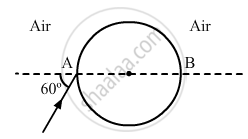
A ray of light falls on a transparent sphere with centre C as shown in the figure. The ray emerges from the sphere parallel to the line AB. Find the angle of refraction at A if the refractive index of the material of the sphere is \[\sqrt{3}\].
A slab of material of dielectric constant K has the same area as that of the plates of a parallel plate capacitor but has the thickness d/3, where d is the separation between the plates. Find out the expression for its capacitance when the slab is inserted between the plates of the capacitor.
A parallel-plate capacitor has plate area 20 cm2, plate separation 1.0 mm and a dielectric slab of dielectric constant 5.0 filling up the space between the plates. This capacitor is joined to a battery of emf 6.0 V through a 100 kΩ resistor. Find the energy of the capacitor 8.9 μs after the connections are made.
A parallel plate air condenser has a capacity of 20µF. What will be a new capacity if:
1) the distance between the two plates is doubled?
2) a marble slab of dielectric constant 8 is introduced between the two plates?
Answer the following question.
Describe briefly the process of transferring the charge between the two plates of a parallel plate capacitor when connected to a battery. Derive an expression for the energy stored in a capacitor.
For a one dimensional electric field, the correct relation of E and potential V is _________.
In a parallel plate capacitor, the capacity increases if ______.
A parallel plate capacitor is connected to a battery as shown in figure. Consider two situations:

- Key K is kept closed and plates of capacitors are moved apart using insulating handle.
- Key K is opened and plates of capacitors are moved apart using insulating handle.
Choose the correct option(s).
- In A: Q remains same but C changes.
- In B: V remains same but C changes.
- In A: V remains same and hence Q changes.
- In B: Q remains same and hence V changes.
A parallel plate capacitor filled with a medium of dielectric constant 10, is connected across a battery and is charged. The dielectric slab is replaced by another slab of dielectric constant 15. Then the energy of capacitor will ______.
A parallel plate capacitor is charged by connecting it to a battery through a resistor. If I is the current in the circuit, then in the gap between the plates:
What is a capacitor that consists of two large, parallel, conducting plates separated by a small distance called?
For two plates separated by distance \[d\], what is the capacitance of a parallel plate capacitor without a dielectric medium?
Substituting \[V=\frac{Qd}{\varepsilon_0 A}\] into \[C=\frac{Q}{V}\] gives which capacitance?
What is the effect of inserting a dielectric with \[K>1\] between the plates?
In electronic circuits, what are filters and oscillators used for?
