Advertisements
Advertisements
प्रश्न
An air-filled parallel-plate capacitor is to be constructed which can store 12 µC of charge when operated at 1200 V. What can be the minimum plate area of the capacitor? The dielectric strength of air is `3 xx 10^6 "Vm"^-1`
Advertisements
उत्तर
Charge that the capacitor can hold = 12 μC
Operating voltage = 1200 V
Breakdown strength, b = `3 xx 10^6 "Vm"^-1`
The separation between the plates of the capacitor is given by `d = V/b = 1200/(3 xx 10^6) = 4 xx 10^-4 "m"`
The capacitance of the capacitor is given by `C = Q/V = (12 xx 10^-6)/1200 = 10^-8 "F"`
The capacitance can be expressed in terms of the area of the plates (A) and the separation of the plates (d) as : `C = (∈_0A)/d = 10^-8 "F"`
Thus, the area of the plates is given by
`A = (10^-8 xx (4 xx 10^-4))/(8.854 xx 10^-12) = 0.45 "m"^2`
APPEARS IN
संबंधित प्रश्न
When an AC source is connected to an ideal capacitor, show that the average power supplied by the source over a complete cycle is zero
A parallel plate capacitor of capacitance C is charged to a potential V. It is then connected to another uncharged capacitor having the same capacitance. Find out the ratio of the energy stored in the combined system to that stored initially in the single capacitor.
As `C = (1/V) Q` , can you say that the capacitance C is proportional to the charge Q?
Two metal spheres of capacitance C1 and C2 carry some charges. They are put in contact and then separated. The final charges Q1 and Q2 on them will satisfy
The plates of a parallel-plate capacitor are made of circular discs of radii 5⋅0 cm each. If the separation between the plates is 1⋅0 mm, what is the capacitance?
Convince yourself that parts (a), (b) and (c) figure are identical. Find the capacitance between the points A and B of the assembly.
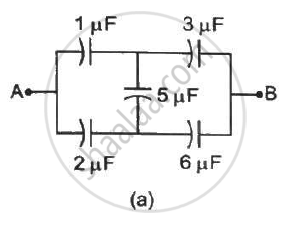
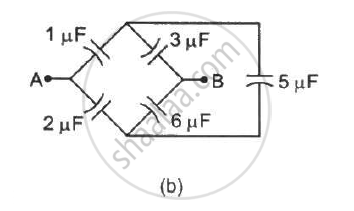
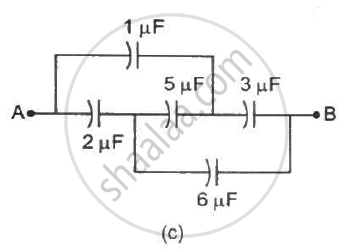
A parallel-plate capacitor of capacitance 5 µF is connected to a battery of emf 6 V. The separation between the plates is 2 mm. (a) Find the charge on the positive plate. (b) Find the electric field between the plates. (c) A dielectric slab of thickness 1 mm and dielectric constant 5 is inserted into the gap to occupy the lower half of it. Find the capacitance of the new combination. (d) How much charge has flown through the battery after the slab is inserted?
A capacitor is formed by two square metal-plates of edge a, separated by a distance d. Dielectrics of dielectric constant K1 and K2 are filled in the gap as shown in figure . Find the capacitance.
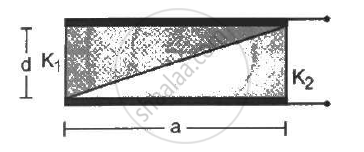
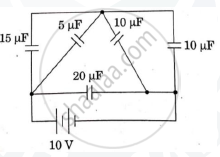
The figure show a network of five capacitors connected to a 10V battery. Calculate the charge acquired by the 5μF capacitor.
Obtain an expression for equivalent capacitance when three capacitors C1, C2 and C3 are connected in series.
The work done in placing a charge of 8 × 10–18 coulomb on a condenser of capacity 100 micro-farad is ______.
The capacitance of a parallel plate capacitor is 60 µF. If the distance between the plates is tripled and area doubled then new capacitance will be ______.
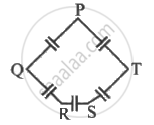
Five capacitor each of capacitance value C are connected as shown in the figure. The ratio of capacitance between P to R, and the capacitance between P and Q is ______.
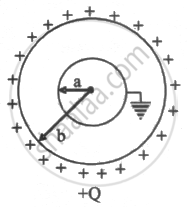
Two spherical conductors A and B of radii a and b(b > a) are placed concentrically in the air. B is given a charge +Q and A is earthed. The equivalent capacitance of the system is ______.
Two similar conducting spheres having charge+ q and -q are placed at 'd' seperation from each other in air. The radius of each ball is r and the separation between their centre is d (d >> r). Calculate the capacitance of the two ball system ______.

In a series combination, which capacitor gets a larger potential difference?
In a parallel combination, which quantity is the same across each capacitor?
What is the practical purpose of a parallel combination of capacitors?
