Advertisements
Advertisements
प्रश्न
A capacitor of unknown capacitance is connected across a battery of V volts. The charge stored in it is 300 μC. When potential across the capacitor is reduced by 100 V, the charge stored in it becomes 100 μC. Calculate The potential V and the unknown capacitance. What will be the charge stored in the capacitor if the voltage applied had increased by 100 V?
Advertisements
उत्तर
(i) Initial voltage, V1 = V volts, Charge stored,Q1 = 300 µC
Q1 = CV1 ..(1)
Changed potential, V2 = V-100 V
Q2 = 100 µC
Q2 = CV2 ..(2)
By dividing (2) from (1), we get `(Q_1)/(Q_2) = (CV_1)/(CV_2) => Q_1/Q_2 = V_1 /V_2`
`=> 300/100 = V/(V- 100) => V = 150 \text { volts }`
`∴ C = Q_1/V_1 = (300 xx 10^-6)/150 = 2 xx 10^-6 F = 2 μ F`
(ii) If the voltage applied had increased by 120 V, then V3 = 150+100 = 250 V
Hence, charge stored in the capacitor, Q3 = CV3 = 2×10-6×250 = 500 µC
(ii) If the voltage applied had increased by 120 V, then V3 = 150+100 = 250 V
Hence, charge stored in the capacitor, Q3 = CV3 = 2×10-6×250 = 500 µC
APPEARS IN
संबंधित प्रश्न
(i) Find equivalent capacitance between A and B in the combination given below. Each capacitor is of 2 µF capacitance.
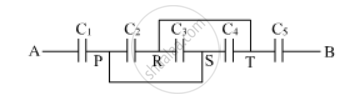
(ii) If a dc source of 7 V is connected across AB, how much charge is drawn from the source and what is the energy stored in the network?
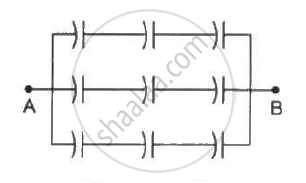
Each of the capacitors shown in figure has a capacitance of 2 µF. find the equivalent capacitance of the assembly between the points A and B. Suppose, a battery of emf 60 volts is connected between A and B. Find the potential difference appearing on the individual capacitors.
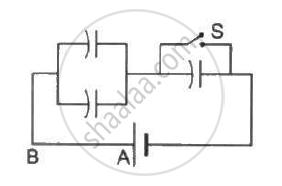
Each capacitor shown in figure has a capacitance of 5⋅0 µF. The emf of the battery is 50 V. How much charge will flow through AB if the switch S is closed?
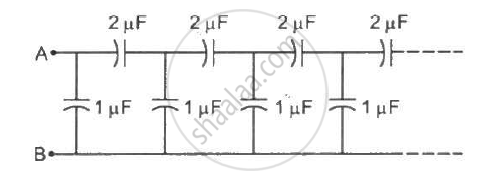
Find the equivalent capacitance of the infinite ladder shown in figure between the points A and B.
If the voltage applied on a capacitor is increased from V to 2V, choose the correct conclusion.
Explain in detail the effect of a dielectric placed in a parallel plate capacitor.
Dielectric constant for a metal is ______.
The radius of a sphere of capacity 1 microfarad in the air is ______
Consider two conducting spheres of radii R1 and R2 with R1 > R2. If the two are at the same potential, the larger sphere has more charge than the smaller sphere. State whether the charge density of the smaller sphere is more or less than that of the larger one.
Which statement describes the voltage and use of a parallel combination?
