Advertisements
Advertisements
प्रश्न
Explain in detail the effect of a dielectric placed in a parallel plate capacitor.
Advertisements
उत्तर
- When the capacitor is disconnected from the battery:
Consider a capacitor with two parallel plates each of cross-sectional area A and are separated by a distance d. The capacitor is charged by a battery of voltage V0 and the charge stored is Q0. The capacitance of the capacitor without the dielectric is
`"C"_0 = "Q"_0/"V"_0` .....(1)
The battery is then disconnected from the capacitor and the dielectric is inserted between the plates. The introduction of dielectric between the plates will decrease the electric field. Experimentally it is found that the modified electric field is given by
(a) Capacitor is charged with a battery
(b) Dielectric is inserted after the battery is disconnected
E = `"E"_0/ε_"r"` .....(2)
Here E0 is the electric field inside the capacitors when there is no dielectric and εr is the relative permeability of the dielectric or simply known as the dielectric constant. Since εr > 1, the electric field E < E0. As a result, the electrostatic potential difference between the plates (V = Ed) is also reduced. But at the same time, the charge Q0 will remain constant once the battery is disconnected. Hence the new potential difference is
V = Ed = `"E"_0/ε_"r" "d" = "V"_0/ε_"r"` ....(3)
We know that capacitance is inversely proportional to the potential difference. Therefore as V decreases, C increases. Thus new capacitance in the presence of a dielectric is
C = `"Q"_0/"V" = ε_"r" "Q"_0/"V"_0 = ε_"r" "C"_0` .....(4)
Since εr > 1, we have C > C0. Thus insertion of the dielectric constant εr increases the capacitance. Using equation,
C = `(ε_0"A")/"d"`
C = `(ε_"r"ε_0"A")/"d" = (ε"A")/"d"`......(5)
where ε = εrε0 is the permittivity of the dielectric medium. The energy stored in the capacitor before the insertion of a dielectric is given by U0 = `1/2 "Q"_0^2/"C"_0` .....(6)
After the dielectric is inserted, the charge Q0 remains constant but the capacitance is increased. As a result, the stored energy is decreased.
U = `1/2 "Q"_0^2/(2"C") = 1/2 "Q"_0^2/(2 ε_"r""C"_0) = "U"_0/ε_"r"`
Since εr> 1 we get U < U0. There is a decrease in energy because, when the dielectric is inserted, the capacitor spends some energy in pulling the dielectric inside.
- When the battery remains connected to the capacitor:
Let us now consider what happens when the battery of voltage V0 remains connected to the capacitor when the dielectric is inserted into the capacitor.
The potential difference V0 across the plates remains constant. But it is found experimentally (first shown by Faraday) that when dielectric is inserted, the charge stored in the capacitor is increased by a factor εr.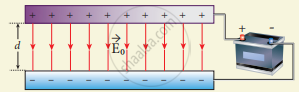
(a) Capacitor is charged through a battery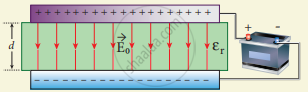
(b) Dielectric is inserted when the battery is connected.
Q = εrQ0 ….. (1)
Due to this increased charge, the capacitance is also increased. The new capacitance is
C = `"Q"_0/"V" = ε_"r" "Q"_0/"V"_0 = ε_"r" "C"_0` ....(2)
However the reason for the increase in capacitance in this case when the battery remains connected is different from the case when the battery is disconnected before introducing the dielectric.
Now, C0 = `(ε_0"A")/"d"` and, C = `(ε"A")/"d"` .....(3)
`"U"_0 = 1/2 "C"_0 "V"_0^2` ....(4)
Note that here we have not used the expression
`"U"_0 = 1/2 "V"_0^2 "C"_0`
because here, both charge and capacitance are changed, whereas in equation 4, V0 remains constant. After the dielectric is inserted, the capacitance is increased; hence the stored energy is also increased.
U = `1/2 "CV"_0^2 = 1/2 ε_"r" "CV"_0^2 = ε_"r" "U"_0`
Since er > 1 we have U > U0
It may be noted here that since voltage between the capacitor V0 is constant, the electric field between the plates also remains constant.
APPEARS IN
संबंधित प्रश्न
Two capacitors each having capacitance C and breakdown voltage V are joined in series. The capacitance and the breakdown voltage of the combination will be
Following operations can be performed on a capacitor:
X − connect the capacitor to a battery of emf ε.
Y − disconnect the battery.
Z − reconnect the battery with polarity reversed.
W − insert a dielectric slab in the capacitor.
(a) In XYZ (perform X, then Y, then Z) the stored electric energy remains unchanged and no thermal energy is developed.
(b) The charge appearing on the capacitor is greater after the action XWY than after the action XYZ.
(c) The electric energy stored in the capacitor is greater after the action WXY than after the action XYW.
(d) The electric field in the capacitor after the action XW is the same as that after WX.
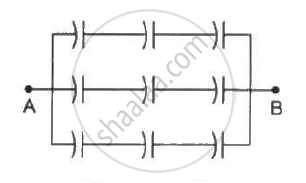
Each of the capacitors shown in figure has a capacitance of 2 µF. find the equivalent capacitance of the assembly between the points A and B. Suppose, a battery of emf 60 volts is connected between A and B. Find the potential difference appearing on the individual capacitors.
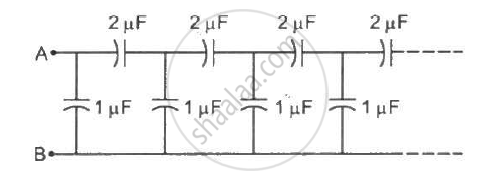
Find the equivalent capacitance of the infinite ladder shown in figure between the points A and B.
Obtain an expression for equivalent capacitance when three capacitors C1, C2 and C3 are connected in series.
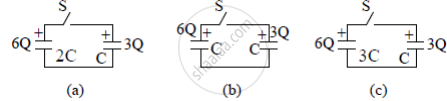
Three circuits, each consisting of a switch 'S' and two capacitors, are initially charged, as shown in the figure. After the switch has been closed, in which circuit will the charge on the left-hand capacitor
(i) increase,
(ii) decrease, and
(iii) remains the same? Give reasons.
When air is replaced by a dielectric medium of constant K, the maximum force of attraction between two charges separated by a distance ______.
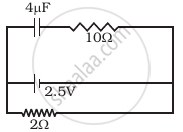
A capacitor of 4 µ F is connected as shown in the circuit (Figure). The internal resistance of the battery is 0.5 Ω. The amount of charge on the capacitor plates will be ______.
Consider two conducting spheres of radii R1 and R2 with R1 > R2. If the two are at the same potential, the larger sphere has more charge than the smaller sphere. State whether the charge density of the smaller sphere is more or less than that of the larger one.
Can the potential function have a maximum or minimum in free space?
