Advertisements
Advertisements
प्रश्न
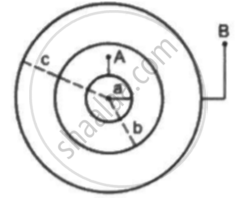
Consider an assembly of three conducting concentric spherical shell of radii a, b and c as shown in figure Find the capacitance of the assembly between the points Aand B.
Advertisements
उत्तर
The spherical shells form two spherical capacitors: one made by A and B and the other made by B and C.
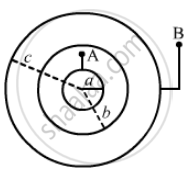
The capacitance of the spherical capacitor made by the shells of radii r1 and r2 is given by
`C = (4pi∈_0)/[[1/r_1 - 1/r^2]] = (4pi∈_0r_1r_2)/(r_2 - r_1)`
The capacitance of the capacitor made by A and B is given by
`C_(AB) = (4pi∈_0ab)/(b-a)`
The capacitance of the capacitor made by B and C is given by
`C_(BC) = (4pi∈_0bc)/(c-b)`
As the capacitors are in series, the net capacitance is given by
`1/C = 1/C_(AB) + 1/C_(BC)`
⇒ `C = (C_(AB)C_(BC))/(C_(AB)+C_(BC)) = (((4pi∈_0)^2 ab^2c)/((b-a)(c-b)))/((4pi∈_0ab)/((b-a))+(4pi∈_0bc)/((c-b))`
⇒ `C = ((4pi∈_0ab^2c)/((b-a)(c-b)))/(((ab(c-b)+bc(b-a))/((b-a)(c-b))))`
⇒ `C = (4pi∈_0ab^2c)/[[ab(c-b)+bc(b-a)]]`
⇒ `C = (4pi∈_0ab^2c)/(b^2(c-a)) = (4pi∈_0ac)/((c-a))`
APPEARS IN
संबंधित प्रश्न
A capacitor of capacitance ‘C’ is charged to ‘V’ volts by a battery. After some time the battery is disconnected and the distance between the plates is doubled. Now a slab of dielectric constant, 1 < k < 2, is introduced to fill the space between the plates. How will the following be affected? (a) The electric field between the plates of the capacitor Justify your answer by writing the necessary expressions.
A capacitor of capacitance ‘C’ is charged to ‘V’ volts by a battery. After some time the battery is disconnected and the distance between the plates is doubled. Now a slab of dielectric constant, 1 < k < 2, is introduced to fill the space between the plates. How will the following be affected? (b) The energy stored in the capacitor Justify your answer by writing the necessary expressions
A parallel plate capacitor of capacitance C is charged to a potential V. It is then connected to another uncharged capacitor having the same capacitance. Find out the ratio of the energy stored in the combined system to that stored initially in the single capacitor.
As `C = (1/V) Q` , can you say that the capacitance C is proportional to the charge Q?
Suppose, one wishes to construct a 1⋅0 farad capacitor using circular discs. If the separation between the discs be kept at 1⋅0 mm, what would be the radius of the discs?
Two conducting spheres of radii R1 and R2 are kept widely separated from each other. What are their individual capacitances? If the spheres are connected by a metal wire, what will be the capacitance of the combination? Think in terms of series−parallel connections.
A parallel-plate capacitor has plate area 100 cm2 and plate separation 1⋅0 cm. A glass plate (dielectric constant 6⋅0) of thickness 6⋅0 mm and an ebonite plate (dielectric constant 4⋅0) are inserted one over the other to fill the space between the plates of the capacitor. Find the new capacitance.
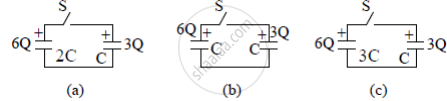
Three circuits, each consisting of a switch 'S' and two capacitors, are initially charged, as shown in the figure. After the switch has been closed, in which circuit will the charge on the left-hand capacitor
(i) increase,
(ii) decrease, and
(iii) remains the same? Give reasons.
If the voltage applied on a capacitor is increased from V to 2V, choose the correct conclusion.
A parallel plate capacitor stores a charge Q at a voltage V. Suppose the area of the parallel plate capacitor and the distance between the plates are each doubled then which is the quantity that will change?
During a thunder storm, the movement of water molecules within the clouds creates friction, partially causing the bottom part of the clouds to become negatively charged. This implies that the bottom of the cloud and the ground act as a parallel plate capacitor. If the electric field between the cloud and ground exceeds the dielectric breakdown of the air (3 × 10⁶ Vm–1), lightning will occur.
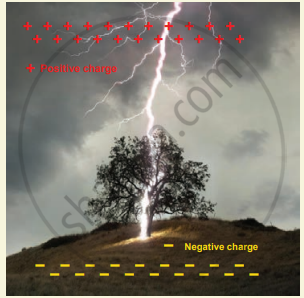
- If the bottom part of the cloud is 1000 m above the ground, determine the electric potential difference that exists between the cloud and ground.
- In a typical lightning phenomenon, around 25 C of electrons are transferred from cloud to ground. How much electrostatic potential energy is transferred to the ground?
The work done in placing a charge of 8 × 10–18 coulomb on a condenser of capacity 100 micro-farad is ______.
A capacitor has charge 50 µC. When the gap between the plate is filled with glass wool, then 120 µC charge flows through the battery to capacitor. The dielectric constant of glass wool is ______.
If the plates of a parallel plate capacitor connected to a battery are moved close to each other, then:
- the charge stored in it. increases.
- the energy stored in it, decreases.
- its capacitance increases.
- the ratio of charge to its potential remains the same.
- the product of charge and voltage increases.
Choose the most appropriate answer from the options given below:
Two spherical conductors of capacities 4 µF and 3 µF are charged to same potential having radii 4 cm and 3 cm respectively. If ‘σ1’ and ‘σ2’ represent surface density of charge on respective conductors then ______.
In a series combination, which quantity is the same on each capacitor?
What is the practical purpose of a series combination of capacitors?
Which statement describes the voltage and use of a parallel combination?
