Advertisements
Advertisements
प्रश्न
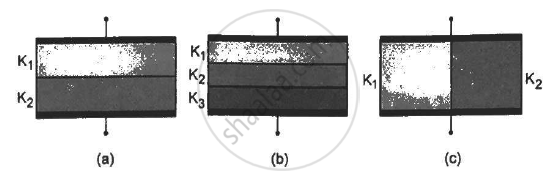
Find the capacitances of the capacitors shown in figure . The plate area is Aand the separation between the plates is d. Different dielectric slabs in a particular part of the figure are of the same thickness and the entire gap between the plates is filled with the dielectric slabs.
Advertisements
उत्तर
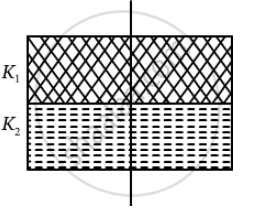
The two parts of the capacitor are in series with capacitances C1 and C2.
Here,
`C_1 = (K_1∈_0A)/(d/2) and C_2 = (K_2∈_0A)/(d/2)`
⇒ `C_1 = (2K_1∈_0A)/d and C_2 = (2K_2∈_0A)/d`
Because they are in series, the net capacitance is calculated as :
`C = (C_1 xx C_2)/(C_1+C_2)`
= `((2K_1∈_0A)/d xx (2K_2∈_0A)/d)/((2K_1∈_0A)/d xx (2K_2∈_0A)/d)`
= `(2K_1K_2∈_0A)/(d(K_1+K_2)`
(b) Here, the capacitor has three parts. These can be taken in series.
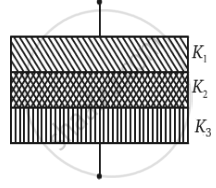
Now ,
`C_1 = (K_1∈_0A)/((d/3)) = (3K_1∈_0A)/d`
`C_2 = (3K_2∈_0A)/d`
`C_3 = (3K_3∈_0A)/d`
Thus, the net capacitance is calculated as :
`C = (C_1 xx C_2 xx C_2)/(C_1C_2+C_2C_3+C_3C_1)`
= `((3K_1∈_0A)/d xx (3K_2∈_0A)/d xx (3K_3∈_0A)/d)/((3K_1∈_0A)/d xx (3K_2∈_0A)/d xx (3K_2∈_0A)/d xx (3K_3∈_0A)/d xx (3K_3∈_0A)/d xx (3K_1∈_0A)/d)`
= `(3 ∈_0 K_1K_2K_3)/(d(K_1K_2+K_2K_3+K_3K_1)`
(c)
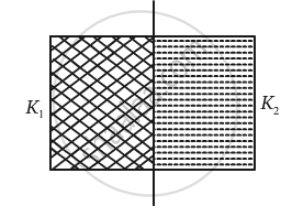
Here ,
`C_1 = (K_1∈_0A/2)/d = (K_1∈_0A)/(2d)`
`C_2 = (K_2∈_0A)/(2d)`
These two parts are in parallel.
`therefore C = C_1 + C_2`
= `(∈_0A)/(2d)(K_1+K_2)`
APPEARS IN
संबंधित प्रश्न
When an AC source is connected to an ideal capacitor, show that the average power supplied by the source over a complete cycle is zero
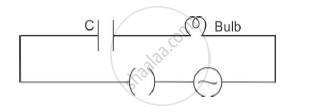
A bulb is connected in series with a variable capacitor and an AC source as shown. What happens to the brightness of the bulb when the key is plugged in and capacitance of the capacitor is gradually reduced?
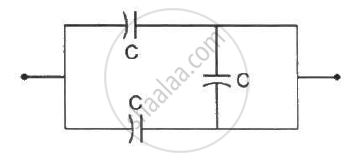
The equivalent capacitance of the combination shown in the figure is _________ .
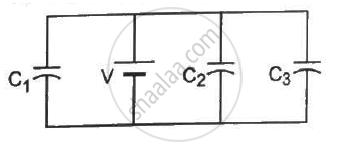
Find the charges on the three capacitors connected to a battery as shown in figure.
Take `C_1 = 2.0 uF , C_2 = 4.0 uF , C_3 = 6.0 uF and V` = 12 volts.
Find the charge supplied by the battery in the arrangement shown in figure.
A parallel-plate capacitor of plate area A and plate separation d is charged to a potential difference V and then the battery is disconnected. A slab of dielectric constant K is then inserted between the plates of the capacitor so as to fill the space between the plates. Find the work done on the system in the process of inserting the slab.
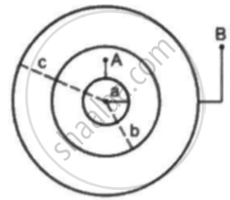
Suppose the space between the two inner shells is filled with a dielectric of dielectric constant K. Find the capacitance of the system between A and B.
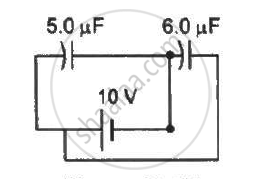
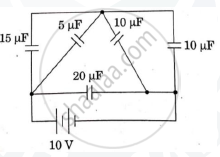
The figure show a network of five capacitors connected to a 10V battery. Calculate the charge acquired by the 5μF capacitor.
A capacitor is charged by a battery. The battery is removed and another identical uncharged capacitor is connected in parallel. The total electrostatic energy of resulting system ______.
The positive terminal of 12 V battery is connected to the ground. Then the negative terminal will be at ______.
The work done in placing a charge of 8 × 10–18 coulomb on a condenser of capacity 100 micro-farad is ______.
When air is replaced by a dielectric medium of constant K, the maximum force of attraction between two charges separated by a distance ______.
Three capacitors 2µF, 3µF, and 6µF are joined in series with each other. The equivalent capacitance is ____________.
A leaky parallel plate capacitor is filled completely with a material having dielectric constant K = 5 and electric conductivity σ = 7.4 × 10⁻¹² Ω-1 m-1. If the charge on the plate at the instant t = 0 is q = 8.85 µC, then the leakage current at the instant t = 12 s is ______ × 10-1 µA.
What is the practical purpose of a series combination of capacitors?
In a parallel combination, which quantity is the same across each capacitor?
In a parallel combination, which statement describes the charges on the capacitors?
What is the practical purpose of a parallel combination of capacitors?
