Advertisements
Advertisements
प्रश्न
A spherical conductor of radius 12 cm has a charge of 1.6 × 10⁻⁷ C distributed uniformly on its surface. What is the electric field
- inside the sphere
- just outside the sphere
- at a point 18 cm from the centre of the sphere?
Advertisements
उत्तर
(a) Radius of the spherical conductor, r = 12 cm = 0.12 m
Charge is uniformly distributed over the conductor, q = 1.6 × 10⁻⁷ C
The electric field inside a spherical conductor is zero. This is because if a field is inside the conductor, then charges will move to neutralize it.
(b) Electric field E just outside the conductor is given by the relation,
`E = q/(4piε_0r^2)`
Where,
`ε_0` = Permittivity of free space
`1/(4piε_0) = 9 xx 10^9` N m2 C−2
∴ `E = (1.6 xx 10^-7 xx 9 xx 10^9)/(0.12)^2`
= `(14.4 xx 10^2)/0.0144`
= 1000 × 102
= 105 N C−1
Therefore, the electric field just outside the sphere is 105 N C−1.
(c) Electric field at a point 18 m from the centre of the sphere = E1
Distance of the point from the centre, d = 18 cm = 0.18 m
`E_1 = q/(4piε_0d^2)`
= `(9 xx 10^9 xx 1.6 xx 10^-7)/(18 xx 10^-2)^2`
= `(14.4 xx 10^2)/(324 xx 10^-4)`
= 0.044 × 106
= 4.4 × 10⁴ N C−1
Therefore, the electric field at a point 18 cm from the centre of the sphere is 4.4 × 10⁴ N C−1.
संबंधित प्रश्न
A spherical conducting shell of inner radius r1 and outer radius r2 has a charge Q.
(a) A charge q is placed at the centre of the shell. What is the surface charge density on the inner and outer surfaces of the shell?
(b) Is the electric field inside a cavity (with no charge) zero, even if the shell is not spherical, but has any irregular shape? Explain.
A 4 µF capacitor is charged by a 200 V supply. It is then disconnected from the supply and is connected to another uncharged 2 µF capacitors. How much electrostatic energy of the first capacitor is lost in the form of heat and electromagnetic radiation?
A 12 pF capacitor is connected to a 50 V battery. How much electrostatic energy is stored in the capacitor? If another capacitor of 6 pF is connected in series with it with the same battery connected across the combination, find the charge stored and potential difference across each capacitor.
A point charge is placed at the centre of a hollow conducting sphere of internal radius ‘r’ and outer radius ‘2r’. The ratio of the surface charge density of the inner surface to that of the outer surface will be ______.
If R is the radius of a spherical conductor, Vm the dielectric strength, then the maximum electric-field magnitude to which it can be raised is ______.
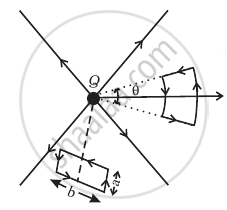
A test charge q is made to move in the electric field of a point charge Q along two different closed paths (Figure). First path has sections along and perpendicular to lines of electric field. Second path is a rectangular loop of the same area as the first loop. How does the work done compare in the two cases?
Consider a finite insulated, uncharged conductor placed near a finite positively charged conductor. The uncharged body must have a potential:
What is the direction of the electric field at the surface of a conductor in electrostatic equilibrium?
What is electrostatic shielding?
What is an equipotential body?
Which expression gives the electric field on a charged conductor surface in vector form?
Which expression gives the magnitude of the electric field on a charged conductor surface?
What does \(\varepsilon_0\) represent in the electric-field formula for a charged conductor surface?
The statement that the electric field inside a conductor is zero is true under which condition?
What would a tangential component of the electric field at a conductor's surface cause?
In the mini derivation of the charged conductor's surface field, what is used with Gauss's law?
Which potential–field relation is used to show that potential is constant inside a conductor?
