Advertisements
Advertisements
Question
Equipotentials at a great distance from a collection of charges whose total sum is not zero are approximately.
Options
spheres
planes
paraboloids
ellipsoids
Advertisements
Solution
spheres
Explanation:
The collection of charges, whose total sum is not zero, with regard to great distance can be considered as a single-point charge. The equipotential surfaces due to a point charge are spherical.
Important point:
- The electric potential due to point charge q is given by V = q/4πε0r
- It means electric potential due to point charge is same for all equidistant points. The locus of these equidistant points, which are at the same potential, form spherical surface.
APPEARS IN
RELATED QUESTIONS
Define an equipotential surface.
The discharging current in the atmosphere due to the small conductivity of air is known to be 1800 A on an average over the globe. Why then does the atmosphere not discharge itself completely in due course and become electrically neutral? In other words, what keeps the atmosphere charged?
Draw the equipotential surfaces due to an electric dipole. Locate the points where the potential due to the dipole is zero.
Draw the equipotential surfaces due to an electric dipole.
Depict the equipotential surface due to
(i) an electric dipole,
(ii) two identical positive charges separated by a distance.
S1 and S2 are the two imaginary surfaces enclosing the charges +q and -q as shown. The electric flux through S1 and S2 are respectively ______.
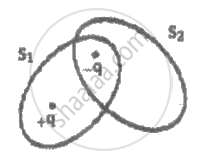
Consider the following statements and select the correct statement(s).
- Electric field lines are always perpendicular to equipotential surface.
- No two equipotential surfaces can intersect each other.
- Electric field lines are in the direction of tangent to an equipotential surface.
- The potential at all the points on an equipotential surface is same.
- Equipotential surfaces never intersect each other.
- Work done in moving a charge from one point to other on an equipotential surface is zero.
Consider a uniform electric field in the ẑ direction. The potential is a constant ______.
- in all space.
- for any x for a given z.
- for any y for a given z.
- on the x-y plane for a given z.
Find the equation of the equipotentials for an infinite cylinder of radius r0, carrying charge of linear density λ.
What is meant by an equipotential surface?
A charge \[q_0\] is moved from point A to point B on the same equipotential surface. If the potentials at A and B are \[V_A\] and \[V_B\] respectively, the work done is:
The surface of any conductor in electrostatic equilibrium is an equipotential surface because:
What is the shape of the equipotential surfaces for a single point charge (+q)?
In a uniform electric field, the equipotential surfaces take the shape of:
For an electric dipole (+q, −q), the equipotential surfaces are best described as:
In the derivation proving \[\vec{E}\] is perpendicular to an equipotential surface, a charge \[q_0\] undergoes a small displacement \[d\vec{l}\] along the surface, with \[\vec{E}\] making an angle \[\theta\] with the displacement. Equating the work expressions leads to which conclusion?
A particle floats between two parallel plates separated by 0.1 m with a potential difference of 4000 V. The particle carries a charge of \[1.6 \times 10^{-19}\] C. Taking \[g = 9.8\ \text{m/s}^2\], the mass of the particle is approximately:
