Advertisements
Advertisements
Question
The electrostatic potential on the surface of a charged conducting sphere is 100V. Two statements are made in this regard S1 at any point inside the sphere, electric intensity is zero. S2 at any point inside the sphere, the electrostatic potential is 100 V. Which of the following is a correct statement?
Options
S1 is true but S2 is false.
Both S1 and S2 are false.
S1 is true, S2 is also true and S1 is the cause of S2.
S1 is true, S2 is also true but the statements are independent.
Advertisements
Solution
S1 is true, S2 is also true and S1 is the cause of S2.
Explanation:
We know, the electric field intensity E and electric potential V are related E = dV/dr
If electric field intensity E = 0, then dV/dr = 0. It means E = 0 inside the charged conducting sphere causes uniform potential inside the sphere. Hence uniform electrostatic potential 100 V will be at any point inside the sphere.
Important points:
- The electric field zero does not necessary imply that electric potential is zero. E.g., the electric field intensity at any point inside the charged spherical shell is zero but there may exist non-zero electric potential.
- If two charged particles of the same magnitude but opposite signs are placed, the electric potential at the midpoint will be zero but the electric field is not equal to zero.
APPEARS IN
RELATED QUESTIONS
A spherical conductor of radius 12 cm has a charge of 1.6 × 10⁻⁷ C distributed uniformly on its surface. What is the electric field
- inside the sphere
- just outside the sphere
- at a point 18 cm from the centre of the sphere?
A spherical conducting shell of inner radius r1 and outer radius r2 has a charge Q.
(a) A charge q is placed at the centre of the shell. What is the surface charge density on the inner and outer surfaces of the shell?
(b) Is the electric field inside a cavity (with no charge) zero, even if the shell is not spherical, but has any irregular shape? Explain.
If Coulomb’s law involved 1/r3 dependence (instead of 1/r2), would Gauss’s law be still true?
Which of the following statement is true?
Three Charges 2q, -q and -q lie at vertices of a triangle. The value of E and V at centroid of triangle will be ______.
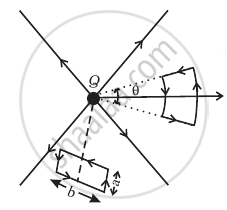
A test charge q is made to move in the electric field of a point charge Q along two different closed paths (Figure). First path has sections along and perpendicular to lines of electric field. Second path is a rectangular loop of the same area as the first loop. How does the work done compare in the two cases?
Consider a finite insulated, uncharged conductor placed near a finite positively charged conductor. The uncharged body must have a potential:
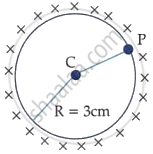
A thin spherical shell is charged by some source. The potential difference between the two points C and P (in V) shown in the figure is:
(Take `1/(4 pi epsilon_0` = 9 × 10⁹ SI units)
What does surface charge density represent, and what symbol denotes it?
Which expression gives the magnitude of the electric field on a charged conductor surface?
In the surface-field expression \[\vec{E}=\frac{\sigma}{\varepsilon_0}\hat{n}\], what does \(\hat{n}\) represent?
What would a tangential component of the electric field at a conductor's surface cause?
For the Gaussian pillbox at a charged conductor's surface, from which face does the flux come?
Which justification is used for the formula \[E=\frac{\sigma}{\varepsilon_0}\]?
What did Faraday use to confirm that the room's interior remained charge-free?
Why can a comb's attraction for paper be weak or absent on a rainy day or when the hair is wet?
Why are special aircraft tyres made slightly conducting?
