Advertisements
Advertisements
Question
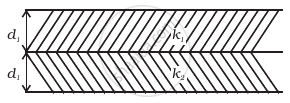
A parallel plate capacitor is made of two dielectric blocks in series. One of the blocks has thickness d1 and dielectric constant k1 and the other has thickness d2 and dielectric constant k2 as shown in figure. This arrangement can be thought as a dielectric slab of thickness d (= d1 + d2) and effective dielectric constant k. The k is ______.
Options
`(k_1d_1 + k_2d_2)/(d_1 + d_2)`
`(k_1d_1 + k_2d_2)/(k_1 + k_2)`
`(k_1k_2 (d_1 + d_2))/((k_1d_1 + k_2d_2))`
`(2k_1k_2)/(k_1 + k_2)`
Advertisements
Solution
A parallel plate capacitor is made of two dielectric blocks in series. One of the blocks has thickness d1 and dielectric constant k1 and the other has thickness d2 and dielectric constant k2 as shown in figure. This arrangement can be thought as a dielectric slab of thickness d (= d1 + d2) and effective dielectric constant k. The k is `underline((k_1k_2 (d_1 + d_2))/((k_1d_1 + k_2d_2)))`.
Explanation:
Here the system can be considered as two capacitors C1 and C2 connected in series as shown in figure.

The capacitance of parallel plate capacitor filled with dielectric block has thickness d1 and dielectric constant K2 is given by
`1/C_(eq) = 1/C_1 + 1/C_2` ⇒ `C_(eq) = (C_1C_2)/(C_1 + C_2)`
`C_(eq) = ((k_1ε_0A)/(d_1))/((k_1ε_0A)/(d_1)) ((k_2ε_0A)/(d_2))/((k_2ε_0A)/(d_2)) = (k_1k_2ε_0A)/(k_1d_2 + k_2d_1)` ......(i)
We can write the equivalent capacitance as `C = (kε_0A)/(d_1 + d_2)` ......(ii)
On comparing (i) and (ii) we have
`k = (k_1k_2(d_1 + d_2))/(k_1d_2 + k_2d_1)`
APPEARS IN
RELATED QUESTIONS
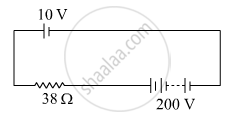
A 10 V battery of negligible internal resistance is connected across a 200 V battery and a resistance of 38Ω as shown in the figure. Find the value of the current in circuit.
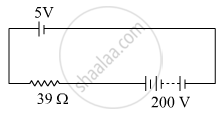
A 5 V battery of negligible internal resistance is connected across a 200 V battery and a resistance of 39Ω as shown in the figure. Find the value of the current in circuit.
A capacitor is made of two circular plates of radius R each, separated by a distance d << R. The capacitor is connected to a constant voltage. A thin conducting disc of radius r<<R and thickness t << r is placed at a centre of the bottom plate. Find the minimum voltage required to lift the disc if the mass of the disc is m.
What is the permittivity of a medium?
How is the dielectric constant of a medium defined as a ratio?
Which description defines a dielectric?
What happens to dielectric molecules when they are placed in an external electric field?
What is dielectric strength?
Which unit and approximate value are given for the dielectric strength of air?
In the parallel plate capacitor reference state, what is assumed about the charge when the battery is disconnected?
For a parallel plate capacitor with no dielectric between its plates, which expression gives the electric field?
What is the potential difference across the plates in the reference state without a dielectric?
What is the stated value of the permittivity of free space?
During polarisation between capacitor plates, how do the charges shift?
What is the capacitance of an isolated parallel plate capacitor when a full dielectric slab of dielectric constant \[K\] is inserted?
Which expression connects the permittivity of a dielectric medium to the capacitance of a full-slab parallel plate capacitor?
A dielectric slab with thickness \[t=\frac{3d}{4}\] and dielectric constant \[K\] is inserted into a gap of separation \[d\). What is the new capacitance in terms of the original capacitance \[C_0\]?
