Advertisements
Advertisements
Question
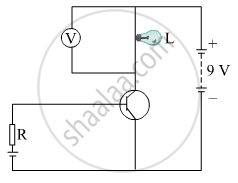
In the given circuit diagram a voltmeter ‘V’ is connected across a lamp ‘L’. Ho would (i) the brightness of the lamp and (ii) voltmeter reading ‘V’ be affected, if the value of resistance ‘R’ is decreased? Justify your answer.
Advertisements
Solution
The given figure is Common Emitter (CE) configuration of an npn transistor. The input circuit is forward biased and collector circuit is reverse biased.
As the base resistance R decreases, the input circuit will become more forward biased thus decreasing the base current (IB) and increasing the emitter current (IE). This will increase the collector current (IC) as IE = IB + IC.
When IC increases which flows through the lamp, the voltage across the bulb will also increase thus making the lamp brighter and as the voltmeter is connected in parallel with the lamp, the reading in the voltmeter will also increase.
APPEARS IN
RELATED QUESTIONS
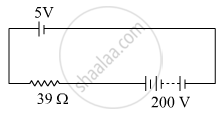
A 5 V battery of negligible internal resistance is connected across a 200 V battery and a resistance of 39Ω as shown in the figure. Find the value of the current in circuit.
A capacitor is made of two circular plates of radius R each, separated by a distance d << R. The capacitor is connected to a constant voltage. A thin conducting disc of radius r<<R and thickness t << r is placed at a centre of the bottom plate. Find the minimum voltage required to lift the disc if the mass of the disc is m.
What is the permittivity of a medium?
What is polarisation?
What is dielectric strength?
Which unit and approximate value are given for the dielectric strength of air?
During polarisation between capacitor plates, how do the charges shift?
How is the net electric field related to the external field and the induced opposing field in a dielectric?
What is the capacitance of an isolated parallel plate capacitor when a full dielectric slab of dielectric constant \[K\] is inserted?
A dielectric slab with thickness \[t=\frac{3d}{4}\] and dielectric constant \[K\] is inserted into a gap of separation \[d\). What is the new capacitance in terms of the original capacitance \[C_0\]?
