Advertisements
Advertisements
Question
Block diagram of a receiver is shown in the figure:
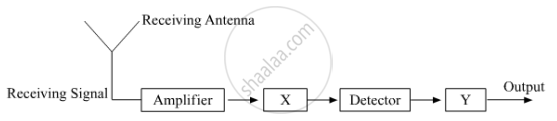
(a) Identify ‘X’ and ‘Y’.
(b) Write their functions.
Advertisements
Solution
From the given block diagram of Demodulation of a typical receiver, we can conclude the following,
(a) X represents Intermediate Frequency (IF) stage while Y represents an Amplifier.
(b) At IF stage, the carrier frequency is changed to a lower frequency and in this process, the modulated signal is detected. While the function of amplifier is to amplify the detected signal which may not be strong enough to be made use of and hence is required.
APPEARS IN
RELATED QUESTIONS
Frequencies in the UHF range normally propagate by means of:
(a) Ground waves.
(b) Sky waves.
(c) Surface waves.
(d) Space waves.
Whatis the difference between analogue signal and. digital signal?
Write any two factors which justify the need for modulating a signal ?
Write briefly any two factors which demonstrate the need for modulating a signal. Draw a suitable diagram to show amplitude modulation using a sinusoidal signal as the modulating signal.
What do you mean by bandwidth of a signal? Give its importance.
A TV tower has a height of 100 meter. If the coverage range is to be made three times then the height of the tower should be increased by.
Broadcasting antennas are generally
What is meant by deviation in frequency of FM wave?
Broadcast band in which FM lies is ______.
Would sky waves be suitable for transmission of TV signals of 60 MHz frequency?
