Advertisements
Advertisements
प्रश्न
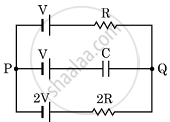
In the circuit three ideal cells of e.m.f. V, V and 2V are connected to a resistor of resistance R, a capacitor of capacitance C and another resistor of resistance 2R as shown in figure. In the steady state find:
- the potential difference between P and Q and
- potential difference across capacitor C.
Advertisements
उत्तर
Take the potential of Q as reference (0). Let Vp = Vp − VQ be the unknown potential difference between P and Q that we must find. Assume each battery has its positive terminal connected to the left node P (as drawn). For a branch with emf E and series resistance r (battery on left, resistor on right), the steady current from P to Q is:
I = `(V_p - E)/r`
Sum of currents (from P to Q) in all branches must be zero (no external injection at P):
`I_"top" + I_"mid" + I_"bottom"` = 0
i. In steady state Imid = 0 (capacitor open), so,
`(V_p - V)/R + (V_p - 2V)/(2R)` = 0
Multiply by 2R to clear denominators:
2(Vp − V) + (Vp − 2V) = 0
Combine terms:
2Vp − 2V + Vp − 2V = 0
⇒ 3Vp − 4V = 0
⇒ Vp = `4/3 V` ...(i)
ii. Let the node between the battery and capacitor be A. Then,
VA = VP − V
= Vp − V
The capacitor is between A and Q, so the voltage across the capacitor (left plate minus right plate) is:
VC = VA − VQ
VC = Vp − V
VC = `4/3 V - V` ...[From equation (i)]
VC = `1/3 V`
C = `V/3`
