Advertisements
Advertisements
Question
Write a short note on dispersion of light.
Advertisements
Solution
Dispersion of light:-
The phenomenon of splitting of light into its component colours is called dispersion of light. When white light passes through a glass prism, it spreads out into a band of different colours which constitute the spectrum of light. The colours in the spectrum of white light are violet, indigo, blue, green, yellow, orange and red. Dispersion takes place because the refractive index of a material such as glass or water is different for different colours. It is maximum for violet colour and minimum for red colour. Hence, in the spectrum of white light obtained with a prism, violet light is deviated the most, while red light is deviated the least. The deviation of light corresponding to other colours lies in between these two colours.
APPEARS IN
RELATED QUESTIONS
When rays of light are incident on a glass slab then the incident ray and emergent ray are _________ each other.
- perpendicular
- parallel
- opposite
- concurrent
After tracing the path of a ray of light passing through a rectangular glass slab for four different values of the angle of incidence, a student reported his observations in tabular form as given below:
| S.No | ∠ i | ∠ r | ∠ e |
| I | 30° | 19° | 29° |
| II | 40° | 28° | 40° |
| III | 50° | 36° | 50° |
| IV | 60° | 40° | 59° |
The best observation is
(A) I
(B) II
(C) III
(D) IV
Why do we get a spectrum of seven colors when white light is dispersed by a prism?
Which of the above wavelengths has a higher frequency?
Write the relation between the angle of incidence and the angle of refraction for a medium.
A monochromatic ray of light passes from air to glass. The wavelength of light in air is λ, the speed of light in air is c and in glass is V. If the absolute refractive index of glass is 1.5, write down
- the relationship between c and V,
- the wavelength of light in glass.
Complete Fig. 4.32 to show the path of the ray of single colour as it enters the prism and emerges out of it. Mark the angles wherever necessary.
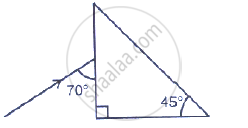
Select from the following the best experimental set-up for tracing the path of a ray of light through a glass slab: (A) I
(A) I
(B) II
(C) III
(D) IV
Four students showed the following traces of the path of a ray of light passing through a rectangular glass slab.

The trace most likely to be correct is that of student
(A) I
(B) II
(C) III
(D) IV
How does the deviation produced by a prism depend on the refraction index of its material.
Which colour of light travels fastest in any medium except air?
Write a relation between the angle of incidence (i), angle of emergence (e), angle of the prism (A), and angle of deviation (d) for a ray of light passing through an equilateral prism.
Name the material for which the refractive index is found to be maximum.
What is the refractive index of vacuum
Comment on the statement ‘The refractive index of glass is 3/2.’
Draw ray of light bending towards the normal while passing from glass to water. Label your diagrams.
Complete the ray diagram showing its emergence into the air after passing through the prism.

A ray of light is incident at an angle of 45° on one face of a rectangular glass slab of thickness 10 cm and refractive index 3/2. Calculate the lateral shift produced ______.
