Advertisements
Advertisements
Question
A ray of light passes from water to air. How does the speed of light change?
Advertisements
Solution
When light passes from water to air i.e., from denser to rarer its speed increases.
RELATED QUESTIONS
Name one factor that affects the lateral displacement of light as it passes through a rectangular glass slab.
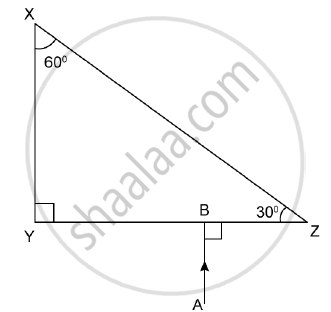
The following diagram shows a 60°, 30°, 90° glass prism of critical angle 42°, Copy the diagram and complete the path of incident ray AB emerging out of the prism marking the angle of incidence on each surface.
When a ray of light from air enters a denser medium, it ______.
A ray of light of wavelength 6600 Å suffer refraction from air to glass. Taking \[\ce{_a\mu_g = \frac{3}{2}}\], find the wavelength of light in glass.
How does the speed of light change when it passes from glass to water?
A pond appears to be 2.7 m deep. If the refractive index of water is `4/3`, find the actual depth of the pond.
A ray of light falls normally on the surface of a transparent glass slab. Draw a ray diagram to show its path and also mark angle of incidence and angle of emergence.
Name the material for which the refractive index is found to be maximum.
The refractive index of glass with respect to air is 1.5. What is the value of the refractive index of air with respect to glass?
Consider these indices of refraction: glass: 1.52; air: 1.0003; water: 1.333. Based on the refractive indices of three materials, arrange the speed of light through them in decreasing order.
