Advertisements
Advertisements
Question
A ray of light PQ is incident normally on the hypotenuse of a right-angled prism ABC as shown in the diagram given below:

(i) Copy the diagram and complete the path of the ray PQ till it emerges from the prism.
(ii) What is the value of the angle of deviation of the ray?
(iii) Name an instrument where this action of the prism is used.
Advertisements
Solution
(i)
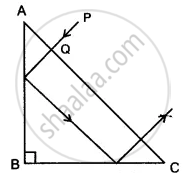
(ii) Angle of deviation of the ray = 180°.
(iii) Prism Binoculars.
APPEARS IN
RELATED QUESTIONS
Explain how the formation of a rainbow occurs.
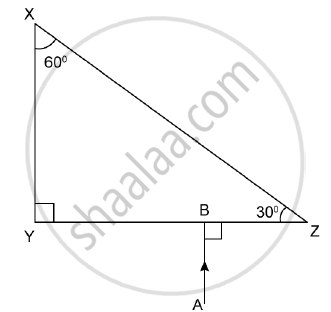
The following diagram shows a 60°, 30°, 90° glass prism of critical angle 42°, Copy the diagram and complete the path of incident ray AB emerging out of the prism marking the angle of incidence on each surface.
How does the angle of deviation produced by a prism change with increase in the angle of incidence. Draw a curve showing the variation in the angle of deviation with the angle of incidence at a prism surface.
How does the angle of minimum deviation produces by a prism change with increase in :
the wavelength of incident light
A light ray in passing from water to a medium
(a) speeds up
(b) slows down. In each case, give one example of the medium.
A student traces the path of a ray of white light through a rectangular glass slab and marks, the angles of incidence (∠i) , refraction (∠r) and emergence (∠e) as shown. Which angle or angles has he not marked correctly?

(A) ∠i only
(B) ∠i and ∠r
(C) ∠i and ∠e
(D) ∠r and ∠e
Light of a single colour is passed through a liquid having a piece of glass suspended in it. On changing the temperature of liquid, at a particular temperature, the glass piece is not seen.
Why is the light of a single colour used ?
Why does a fisherman aim at the tail of fish during spearfishing?
A fish swimming in a pond seems nearer than it really is. Explain.
What is the total reflecting prism?
