Advertisements
Advertisements
Question
Explain how the formation of a rainbow occurs.
Advertisements
Solution
(i) The formation of a rainbow in the sky is a combined result of refraction, dispersion and reflection of sunlight by water droplets present in the atmosphere after it has rained.

(ii) Sunlight is a mixture of seven colours: Violet, indigo, blue, green, yellow, orange and red. After it has stopped raining, the atmosphere contains a large number of water droplets. When sunlight is incident on a water droplet, there is
- Refraction and dispersion of light as it passes from air to water
- Internal reflection of light inside the droplet
- Refraction of light as it passes from water to air
(iii) The refractive index of water is different for different colours, being maximum for violet and minimum for red. Hence, there is dispersion of light (separation into different colours) as it passes from air to water.
(iv) The combined action of different water droplets (acting like tiny prisms) produces a rainbow with red colour on the outer side and violet colour on the inner side. The remaining five colours lie between these two colours. The rainbow is seen when the Sun is behind the observer and the water droplets are in the front.
APPEARS IN
RELATED QUESTIONS
What is a spectrum?
Explain the term absolute refractive index of a medium and write an expression to relate it with the speed of light in vacuum.
State the dependence of angle of deviation on the wavelength of light
Name one factor that affects the lateral displacement of light as it passes through a rectangular glass slab.
A monochromatic ray of light passes from air to glass. The wavelength of light in air is λ, the speed of light in air is c and in glass is V. If the absolute refractive index of glass is 1.5, write down
- the relationship between c and V,
- the wavelength of light in glass.
In the adjacent diagram, AO is a ray of light incident on a rectangular glass slab.

- Complete the path of the ray till it emerges out of the slab.
- In the diagram, mark the angle of incidence (i) and the angle of refraction (r) at the first interface. How is the refractive index of glass related to the angles i and r?
- Mark angles of emergence by the letter e. How are the angles i and e related?
- Which two rays are parallel to each other? Name them.
- Indicate in the diagram the lateral displacement between the emergent ray and the incident ray. State one factor that affects the lateral displacement.
When a ray of light from air enters a denser medium, it ______.
The highest refractive index is of ______.
How does the angle of deviation produced by a prism change with increase in the angle of incidence. Draw a curve showing the variation in the angle of deviation with the angle of incidence at a prism surface.
A student has traced the path of a ray of light through a glass slab as follows. If you are asked to label 1, 2, 3 and 4, the correct sequencing of labeling ∠i, ∠e, ∠r and lateral displacement respectively is
(a) 2, 1, 3, 4
(b) 1, 2, 3, 4
(c) 1, 3, 2, 4
(d) 1, 3, 4, 2
-
- the angle of refraction and
- the angle of deviation for the ray?
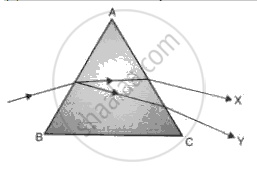
Fig. shows a ray of white light that passes through a prism and produces a spectrum.
(a) Name the phenomenon that is taking place.
(b) What colour would you see at X and Y?
(c) What radiation would you detect above X and below Y?
In an experiment of finding the refractive index of glass, if blue light is replaced by the red light, how will the refractive index of glass change? Give reason in support of your answer.
Choose the correct alternative and rewrite the following:
A glass slab is placed in the path of convergent light. The point of convergence of light
During sunset and sunrise, the sun is seen when it is slightly below the horizon. Give reason.
Can the absolute refractive index of a medium be less than one?
The diagram shows the path of a ray of light through a rectangular glass block placed in a liquid of uniform density.

What should be the rate of the speed of light through the liquid to the speed through the glass so that there is no refraction of light at the boundaries of the glass block when the system is illuminated by the light of one colour?
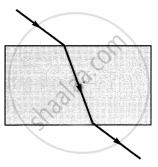
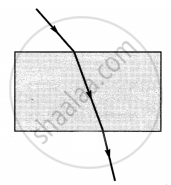
The path of a ray of light coming from air passing through a rectangular glass slab traced by four students are shown as A, B, C and D in the figure. Which one of them is correct?
 |
 |
 |
 |
| A | B | C | D |
Draw the ray diagram of a glass slab having medium A and B for the velocity of light ray VA and VB respectively and define Snell's law.
- If VB = 1.5 VA, then which medium is denser?
- What is the refractive index of A with respect to B?
- What is the refractive index of B with respect to A?
