Advertisements
Advertisements
Question
In the adjacent diagram, AO is a ray of light incident on a rectangular glass slab.

- Complete the path of the ray till it emerges out of the slab.
- In the diagram, mark the angle of incidence (i) and the angle of refraction (r) at the first interface. How is the refractive index of glass related to the angles i and r?
- Mark angles of emergence by the letter e. How are the angles i and e related?
- Which two rays are parallel to each other? Name them.
- Indicate in the diagram the lateral displacement between the emergent ray and the incident ray. State one factor that affects the lateral displacement.
Advertisements
Solution
- The ray's path through the glass slab is complete.
- `""^amu_g = "R.I glass" = sin i/sin r`

- Angle of emergence ∠e is marked ∠i = ∠e
- Emergent ray BD and incident ray AO are parallel.
- DE shows the lateral displacement.
The following factors affect lateral displacement:
- The angle of incidence.
- The glass slab's (or medium's) thickness.
- Refractive index of glass.
APPEARS IN
RELATED QUESTIONS
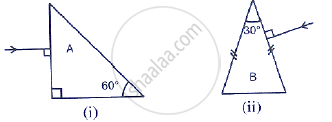
Fig 4.31 below shows a light ray of single colour incident normally on two prisms A and B. In each case draw the path of the ray of light as it enters and emerges out of the prism. Mark the angle wherever necessary.
A postage stamp kept below a rectangular glass block of refractive index 1.5 when viewed from vertically above it, appears to be raised by 7.0 mm. Calculate the thickness of the glass slab.
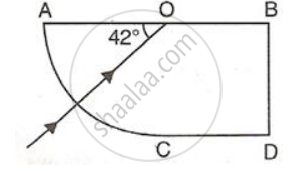
A ray of light enters a glass slab ABDC as shown in figure and strikes at the centre O of the circular part AC of the slab. The critical angle of glass is 42°. Complete the path of the ray till it emerges out from the slab. Mark the angles in the diagram wherever necessary.
“A ray of light incident on a rectangular glass slab immersed in any medium emerges parallel to itself.” Draw labelled ray diagram to justify the statement.
Which colour of light travels fastest in any medium except air?
Comment on the statement ‘The refractive index of glass is 3/2.’
Can the absolute refractive index of a medium be less than one?
Calculate the velocity of light in a glass block of refractive index 1.5. (Velocity of light in air = 3 × 10⁸ m/s)

