Advertisements
Advertisements
प्रश्न
In the adjacent diagram, AO is a ray of light incident on a rectangular glass slab.

- Complete the path of the ray till it emerges out of the slab.
- In the diagram, mark the angle of incidence (i) and the angle of refraction (r) at the first interface. How is the refractive index of glass related to the angles i and r?
- Mark angles of emergence by the letter e. How are the angles i and e related?
- Which two rays are parallel to each other? Name them.
- Indicate in the diagram the lateral displacement between the emergent ray and the incident ray. State one factor that affects the lateral displacement.
Advertisements
उत्तर
- The ray's path through the glass slab is complete.
- `""^amu_g = "R.I glass" = sin i/sin r`

- Angle of emergence ∠e is marked ∠i = ∠e
- Emergent ray BD and incident ray AO are parallel.
- DE shows the lateral displacement.
The following factors affect lateral displacement:
- The angle of incidence.
- The glass slab's (or medium's) thickness.
- Refractive index of glass.
APPEARS IN
संबंधित प्रश्न
What is a spectrum?
Write a short note on dispersion of light.
Name one factor that affects the lateral displacement of light as it passes through a rectangular glass slab.
Fill in the blanks to complete the following sentence
When light travels from a denser to a rarer medium, its speed ……………….
While tracing the path of a ray of light passing through a rectangular glass slab a student tabulated his observations as given below:
|
S.NO. |
∠i |
∠r |
∠e |
|
I |
60° |
40° |
61° |
|
II |
50° |
36° |
51° |
|
III |
40° |
28° |
39° |
|
IV |
30° |
20° |
31° |
The correct observations is:
(A) I
(B) II
(C) III
(D) IV
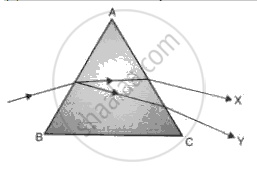
Fig. shows a ray of white light that passes through a prism and produces a spectrum.
(a) Name the phenomenon that is taking place.
(b) What colour would you see at X and Y?
(c) What radiation would you detect above X and below Y?